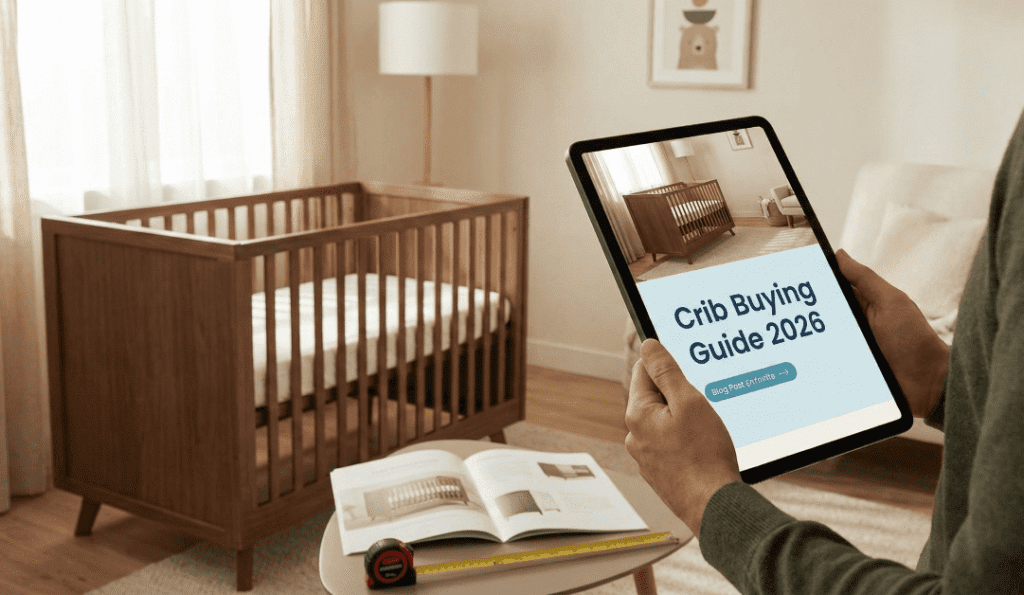
If you’re reading this at 3 AM, one hand scrolling through another crib buying guide while the other rests on your growing belly, you are not alone. I spent six months researching every baby crib buying guide online, joining seventeen parenting groups, and wondering: do I need to buy a crib that costs $1,000, or is the $129 IKEA option just as safe?
Here’s the truth: the “perfect” crib doesn’t exist, but the right crib for YOUR family does.
This consumer reports crib buying guide will walk you through what to look for when buying a crib—the safety non-negotiables, the budget realities, and the real-world truths no one tells you. Let’s find a crib that’s safe, functional, and fits your nursery.

When to Buy a Crib for Baby
Ideally, buy your crib in the second trimester (weeks 14-27). This gives you time to:
- Research and compare options
- Wait for sales (major holidays often have 20-30% off)
- Assemble and safety-check before your third trimester
- Order a matching mattress and allow for shipping delays
Don’t wait until the third trimester. Supply chain issues can cause 4-6 week delays, and you don’t want to be assembling furniture at 38 weeks pregnant.
Top 5 Crib Buying Mistakes (And How to Avoid Them)
Before diving into what to look for when buying a crib, let me save you from the mistakes I see parents make repeatedly.
Mistake #1: Not Measuring the Doorway First
You assemble the crib in the living room, then realize it won’t fit through the nursery doorway. Standard doorways are 30-32 inches wide, but assembled cribs often don’t make it through.
How to avoid it: Measure your doorway first and plan to assemble the crib in the room where it will stay.

Mistake #2: Buying a Convertible Crib Without the Conversion Kit
You buy a 4-in-1 convertible crib thinking you’ll get the kit “when you need it.” Three years later, the finish is discontinued or the kit is sold out everywhere.
How to avoid it: If you buy convertible, buy the conversion kit the same day. Store it until you need it.
Mistake #3: Choosing Style Over Safety
That vintage-inspired crib with decorative cutouts looks perfect for your Pinterest nursery—until you realize the gaps are too wide or the posts are the wrong height.
How to avoid it: Check safety specs before falling in love with the design. You can decorate around a simple crib.
Mistake #4: Assuming Any Standard Mattress Will Fit
Not all “standard” mattresses fit all “standard” cribs perfectly. Manufacturing variations mean some combinations leave dangerous gaps.
How to avoid it: Buy the crib first, measure the interior dimensions, then buy a mattress sized for those exact measurements. Always do the two-finger test on all four sides.
Mistake #5: Waiting Until the Third Trimester
Waiting until you’re 32+ weeks pregnant creates stress. Supply chain delays run 4-6 weeks, preferred models sell out, and you’re too exhausted to assemble furniture.
How to avoid it: Shop during your second trimester (weeks 20-30). You’ll have energy, time for shipping delays, and access to sales.
The “Golden Rules” of Crib Safety (The Non-Negotiables)
Before you look at colors or styles, every crib must pass these federal safety standards. If it doesn’t, keep walking.
The 2011 Standard: Never Compromise on This
Never use a crib manufactured before June 28, 2011. This is when the CPSC banned drop-side rails after they were linked to 32 infant deaths. Drop-side mechanisms would fail, creating gaps where babies’ heads got trapped.
What this means when buying a baby crib:
- That beautiful antique from your aunt? If it has drop-sides or predates 2011, it’s a no
- Facebook Marketplace finds? Ask for the manufacture date and model number
- Always check the CPSC recall database before buying used
Pro tip: Before buying any used crib, text the seller asking for the model number. Google it immediately to check the CPSC recall database and manufacture date BEFORE you waste time driving to see it. I’ve saved countless hours this way.
The “Soda Can” Slat Test
Slats must be no more than 2 3/8 inches (6 cm) apart—roughly the width of a soda can. This prevents a baby’s head or limbs from getting trapped.
When shopping, I literally carried a soda can and tested floor models. If the can slid through easily, that crib failed. Trust the science, not the marketing.
The “Two-Finger” Mattress Test
You shouldn’t fit more than two fingers between the mattress and crib frame. Gaps are suffocation hazards where babies can get wedged.
Here’s the catch: Most cribs don’t include mattresses. Standard full-size cribs are 28″ × 52″, but there’s slight variation.
My process:
- Buy the crib first (or finalize the model)
- Measure interior dimensions
- Buy a mattress designed for those exact measurements
- Test all four sides with the two-finger rule
Pro tip: Take a photo of the crib’s interior dimensions on your phone when you’re at the store. When shopping for mattresses online, you’ll have the exact measurements instead of guessing or having to go back.
No Decorative Cutouts
Solid headboards are safest. Decorative cutouts, heart shapes, or scrollwork can trap a baby’s head or limbs. Any opening larger than 2 3/8 inches is a hazard.
I wanted a crib with scalloped designs, but I could fit three fingers through the arches. I chose a simpler design—once the nursery was decorated, the crib blended in beautifully.
Corner Post Height
Posts should be flush with end panels or taller than 16 inches. Mid-height posts (¼ inch to 16 inches) can catch clothing, pacifier clips, or sleep sacks, creating strangulation risks.
What to look for:
- Flush posts (most modern cribs)
- Very tall posts (20+ inches, like canopy styles)
- Avoid: Mid-height decorative posts
For a complete safety checklist including recall checks and lead paint testing:
[ALSO READ: Crib Safety Standards 101: Slat Gaps, Drop-Sides, and Recall Checks]
What to Look for When Buying a Crib: Types and Features
Standard Cribs: The Budget-Friendly Choice
Standard cribs don’t convert into anything else. Your baby uses them from birth to age 2-3, then you’re done.
When standard cribs make sense:
- You’re having multiple kids close together (you’ll need the crib again)
- Budget is tight—spend money on other essentials
- You’ll choose a toddler bed later with your child
Cost: $100-$500. I bought a $180 standard crib that’s lasted through two kids—four years of use with zero regrets.
Pro tip: Planning multiple kids close together? Buy TWO standard cribs instead of one expensive convertible. Two $150 cribs ($300 total) often cost less than one $600 convertible, and you’ll need both cribs simultaneously anyway.
Convertible Cribs: The Long-Term Investment
Convertible cribs transform into toddler beds, daybeds, or full beds:
- 3-in-1: Crib → Toddler bed → Daybed
- 4-in-1: Crib → Toddler bed → Daybed → Full bed
The catch no one tells you: Most require a separate conversion kit that’s often discontinued by the time you need it (3-4 years later).
If you buy convertible, buy the conversion kit immediately. Finishes get discontinued, companies close, models change. I’ve seen countless moms desperately searching for kits that no longer exist.
When convertible cribs make sense:
- You’re having one child or spacing kids far apart
- You love the idea of keeping the same furniture long-term
- You can buy the crib AND conversion kit upfront
Pro tip: When buying the conversion kit, write the purchase date on the box with a Sharpie and store it with the crib’s assembly instructions. Three years from now, you’ll thank yourself for keeping everything together.
[ALSO READ: Convertible vs. Standard Cribs: Is the “4-in-1” Upgrade Worth the Extra Cost?]
Mini Cribs: The Small-Space Solution
Mini cribs are 24″ × 38″, perfect for:
- Room-sharing during the newborn phase
- Small apartments
- Grandparents’ houses
How long do they last? Most babies fit until around 2 years old, depending on height and climbing ability.
Pros: Space-saving, budget-friendly ($100-$300), often have wheels Cons: Shorter lifespan, fewer market options
Pro tip: If you’re tight on space but want longevity, skip the mini crib and buy a standard crib with wheels. You can roll it around as needed but won’t need to upgrade when the baby outgrows it.
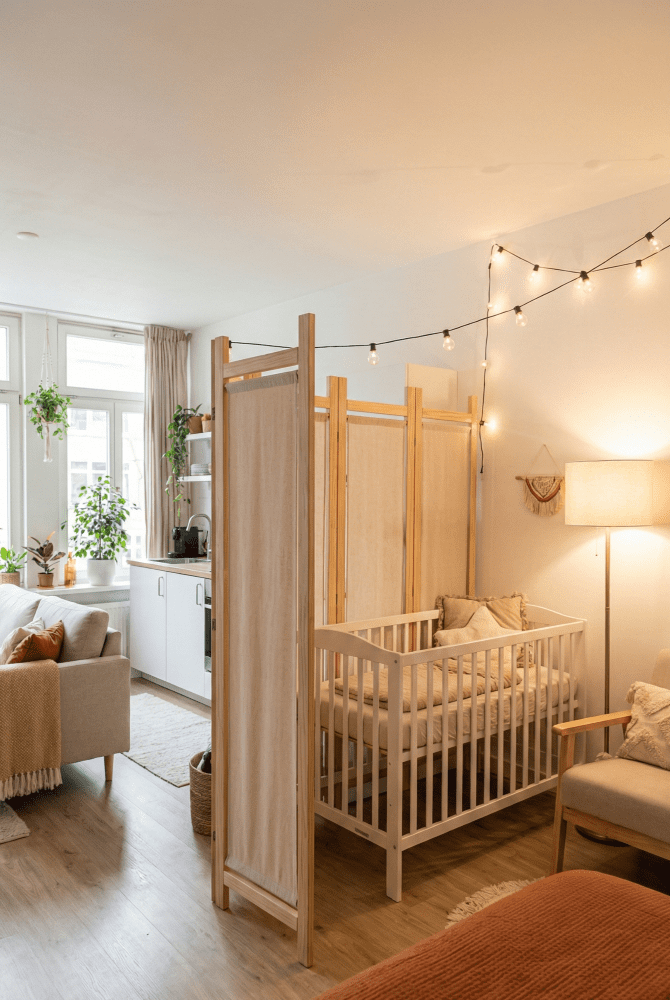
The Small Space Reality: Closet Nurseries
Most baby crib buying guides assume you have a 200-square-foot nursery. Real life? Sometimes the crib goes in a walk-in closet for darkness and privacy.
Is it safe? Yes, if you:
- Check building codes for egress requirements (two exits)
- Never fully close the door—use a mesh cover or prop it open
- Ensure airflow with a fan or air purifier (not pointed at baby)
- Maintain temperature between 68-72°F
- Use a monitor with camera and temperature alerts
Studio apartments: The AAP recommends room-sharing for the first 6-12 months anyway. Use a mini crib, room divider, and blackout curtains to create a nursery corner.
Pro tip: Clip a small room thermometer directly to the crib rail where you can see it clearly during night checks. The $8 thermometer is one of the best safety investments you can make.
Where to Buy a Crib: Online vs. In-Store (Pros & Cons)
Once you know what type of crib you want, where should you actually buy it?
Shopping In-Store
Best for: First-time parents who want to inspect quality in person
Pros: ✅ Test stability and see true colors ✅ Get immediate answers from staff ✅ Take it home today (no shipping delays) ✅ Easier returns
Cons: ❌ Limited selection (20-40 models vs. thousands online) ❌ Higher prices (20-30% markup) ❌ Sales pressure for add-ons
Best stores: Buy Buy Baby, Target, IKEA, Pottery Barn Kids
Shopping Online
Best for: Budget-conscious parents and anyone who’s done their research
Pros:
- ✅ Better prices (20-40% cheaper)
- ✅ Massive selection
- ✅ Read real reviews with photos
- ✅ Shop from home
- ✅ Easy price comparison
Cons:
- ❌ Can’t inspect quality
- ❌ Colors may vary from photos
- ❌ Shipping delays (2-6 weeks)
- ❌ Difficult returns
Best sites: Amazon, Wayfair, Target.com, Babylist, direct from manufacturers
Pro tips for online shopping:
- Read 1-star and 3-star reviews first (they reveal real problems)
- Check multiple sites—same crib can vary by $50-150
- Verify return policy before ordering
- Check delivery time (not just “in stock”)
The Hybrid Approach (My Recommendation)
Step 1: Research online—read reviews, compare prices, watch assembly videos
Step 2: Visit stores to test 3-5 top choices in person
Step 3: Buy wherever the best deal is (many stores price-match)
Real example: The Babyletto Hudson crib I wanted was $399 at Buy Buy Baby, $329 on Amazon. I tested it in-store, bought it on Amazon, and saved $70 toward a better mattress.
For used cribs: Always meet in person. Never buy sight-unseen. You need to verify the manufacture date, check for damage, and test the mattress fit.
Pro tip: Living in a studio? Use a tall bookshelf as a room divider to create a “nursery corner.” The top shelves store baby items, the back faces the crib (creating visual separation), and it’s way cheaper than buying a decorative divider.
Real Mom Truth: The $1,000 Crib vs. The $100 IKEA SNIGLAR
Here’s what no boutique will tell you: A $1,000 crib is NOT safer than a $129 IKEA crib.

They Pass the Same Federal Standards
Every crib sold in the US must meet identical CPSC safety standards—same slat spacing, mattress fit, corner posts, and structural tests. Budget and luxury cribs are equally safe by law.
What you’re paying for with expensive cribs:
- Materials (solid hardwood vs. engineered wood)
- Finish quality and aesthetics
- Brand name
- Longevity through multiple kids
None of these make your baby safer.
The Teething Reality
Around 6-10 months, babies gnaw on crib rails like corn on the cob. Expensive hardwoods get bite marks just like budget models. I’ve seen $800 cribs with chunks missing from the rail.
What actually helps: Silicone rail covers ($20-30) and accepting that cribs are temporary furniture, not heirlooms.
Pro tip: Buy silicone or fabric rail covers BEFORE your baby starts teething (around 4-6 months). Once they start gnawing, the damage happens fast. The $25 covers will save you from looking at bite marks for years.
Where to Actually Spend Your Money
1. A firm, high-quality mattress ($150-250) Your baby spends 12-16 hours daily on this. Look for:
- Firm (not soft or plush)
- Waterproof or waterproof cover
- Greenguard Gold or CertiPUR-US certified
[ALSO READ: The 10 Best Non-Toxic & Greenguard Gold Certified Cribs for Eco-Conscious Moms]
2. A comfortable glider ($300-600) You’ll spend hours nursing, rocking, and reading in this chair at 2 AM. Worth every penny.
3. Blackout curtains and white noise machine ($50-100) These impact sleep more than any $1,000 crib ever will.
My budget: $180 crib, $200 mattress, $450 glider. The crib is fine. The mattress is excellent. The glider is still my favorite piece three years later.
Real Mom Truth: When Your Baby Refuses the Crib
The guidelines say “place baby on their back in the crib.” But what about the “Velcro Baby” who screams the moment their back hits the mattress?
The Hard Line on Safe Sleep
At 2 AM, the temptation to let them sleep in a swing, bouncer, or your bed is overwhelming. But these are linked to SIDS and infant sleep deaths.
Why inclined sleepers are dangerous: When a baby’s head falls forward on an incline, it restricts airflow—called positional asphyxiation. Babies lack the neck strength to reposition themselves.
Never use for unsupervised sleep:
- Swings or bouncy seats
- Inclined sleepers (Rock ‘n Play was recalled in 2019)
- Baby loungers (DockATot, Snuggle Me)
- Car seats (outside the car)
The “Bare Crib” Rule
The safest crib contains only:
- A firm mattress
- A fitted sheet
- Your baby
NOT allowed:
- Pillows: Suffocation risk until toddler bed age
- Stuffed animals: Keep until age 12+ months
- Blankets: Use wearable sleep sacks instead until age 12+ months
- Crib bumpers: Federally banned in 2022, including mesh versions
Even “breathable mesh” bumpers pose entanglement and strangulation risks. If you received them as gifts, don’t use them.
[ALSO READ: How to Transition Your Baby from Bassinet to Crib: A Step-by-Step Sleep Training Guide]
Setup and Maintenance
Build It in the Room
Full-size cribs usually won’t fit through doorways once assembled. Clear the nursery and build it where it’ll stay.
Assembly tips:
- Inventory all hardware against the manual first
- Use correct tools—don’t improvise
- Double-check every bolt after assembly
- Hire TaskRabbit ($50-100) if you’re not handy
The Weekly “Shake Test”
Babies kick, bounce, and shake rails constantly. This loosens hardware over time.
Every week:
- Grab the rail and shake firmly
- Check for wobbling or looseness
- Tighten any loose bolts
- Inspect for cracks, splinters, or damage
Takes two minutes and prevents accidents.
Lowering the Mattress
Most cribs have 3-4 height settings. Adjust as your baby grows:
Highest: Newborn to 4-6 months (before sitting up) Middle: 4-6 to 8-10 months (can sit, before standing) Lowest: 8-10+ months (once pulling to stand)
The rail should be 26+ inches above the mattress to prevent climbing out.
Move the mattress immediately when:
- Baby can push up on hands and knees → middle setting
- Baby can pull to stand → lowest setting
- Child’s chest reaches the top rail → time for a toddler bed
[ALSO READ: When to Lower the Crib Mattress? A Safety Timeline by Age and Milestones]
Do I Need to Buy a Crib? The Honest Answer
Yes, you need a safe sleep space for your baby. But it doesn’t have to be a traditional crib.
Safe sleep alternatives:
- Bassinet: For first 3-6 months, then transition to crib
- Pack ‘n Play with bassinet attachment: Budget dual-purpose option
- Mini crib: If space is extremely limited
What’s NOT a safe sleep space:
- Adult beds (co-sleeping risks)
- Couches or armchairs
- Baby swings or bouncers
- Inclined sleepers
The AAP is clear: babies need a flat, firm surface in their own sleep space. Whether that’s a $100 crib or a $1,000 one doesn’t matter—both do the same job safely.
Frequently Asked Questions (The Real Stuff Parents Actually Ask)
Let’s rapid-fire through the questions I get asked most often—the ones that keep you Googling at 1 AM.
-
When do babies outgrow a crib?
Babies typically outgrow a crib when they reach 35 inches tall or when they start climbing out, whichever comes first. Most children transition to a toddler bed between ages 2-3 years old.
-
When is it safe to give my baby a blanket?
Keep the crib completely bare until your baby is at least 12 months old. After their first birthday, you can introduce a small, lightweight blanket, though many experts recommend waiting until age 2-3. Use wearable sleep sacks until then.
-
Can I use a second-hand crib safely?
Yes, but only if the crib was manufactured after June 28, 2011, has all original hardware intact, hasn’t been recalled, and passes all safety tests (slat spacing under 2 3/8 inches, proper mattress fit). Never use substitute hardware from a hardware store.
-
Are mesh crib bumpers safe?
No. All crib bumpers, including breathable mesh bumpers, were federally banned in 2022 under the Safe Sleep for Babies Act. They pose strangulation and entanglement risks and should never be used.
-
How long does a baby fit in a mini crib?
Most babies fit in a mini crib until they’re around 2 years old, depending on their height and whether they’re attempting to climb out. Mini cribs work well for newborns through the infant stage, typically 18-24 months.
-
What is the maximum slat spacing for a safe crib?
Crib slats must be no more than 2 3/8 inches (6 cm) apart. This prevents a baby’s head or body from getting trapped between the slats.
-
When should I lower the crib mattress?
Lower the mattress to the middle setting when your baby can sit up (4-6 months), and to the lowest setting when they can pull to stand (8-10 months). The rail should be at least 26 inches above the mattress surface.
-
What items are safe to put in a baby’s crib?
Only three items belong in a safe crib: a firm mattress, a fitted sheet, and your baby. No pillows, blankets, stuffed animals, or bumpers should be in the crib until at least 12 months old.
The Car Seat Analogy
Think of buying a baby crib like a car seat. You don’t need the one with heated seats and a DVD player to save your child’s life. As long as it has CPSC and JPMA certification, the “budget” version is as safe as the “luxury” model.
The $129 IKEA crib and the $1,200 designer crib both keep your baby safely contained in a flat, firm sleep space that meets federal regulations. One just costs 10x more and photographs better.
Your job:
- Choose a crib meeting all safety standards
- Set it up and maintain it properly
- Follow safe sleep practices (back to sleep, bare crib, firm mattress)
Do these three things, and your baby will sleep just as soundly—and safely—in any certified crib.
Crib Shopping Checklist: Print & Take to the Store
Here’s your action plan. Screenshot this, print it, or reference it on your phone while shopping.
SAFETY CHECKLIST (NON-NEGOTIABLE)
- ☐ Manufactured after June 28, 2011
- ☐ Slats no more than 2 3/8 inches apart (soda can test)
- ☐ No decorative cutouts
- ☐ Corner posts flush OR taller than 16 inches
- ☐ Passes shake test (no wobbling)
- ☐ Has CPSC and JPMA seals
- ☐ Not on recall list
- ☐ All hardware included (if used)
MEASUREMENTS
- ☐ Doorway width: _____ inches
- ☐ Available floor space: _____ × _____ inches
- ☐ Crib interior dimensions: _____ × _____
- ☐ Two-finger test passed (mattress fit)
BUDGET & PRICING
My Budget:
- Crib: $_____
- Mattress: $_____
- Conversion kit: $_____
- Total: $_____
Price Comparison:
- Store 1: $_____
- Store 2: $_____
- Online: $_____
☐ Checked for current promotions
☐ Asked about price matching
CRIB TYPE & FEATURES
- ☐ Standard / ☐ 3-in-1 / ☐ 4-in-1 / ☐ Mini crib
- ☐ Has 3+ mattress height settings
- ☐ Lowest setting is 26″+ from mattress to rail
If convertible:
- ☐ Conversion kit available NOW
- ☐ Bought kit at same time
DELIVERY & ASSEMBLY
- ☐ Delivery time: _____ days/weeks
- ☐ Shipping cost: $_____
- ☐ Assembly time: _____ minutes
- ☐ Tools needed: _____
RETURN & WARRANTY
- ☐ Return policy: _____ days
- ☐ Return shipping: Free / Paid
- ☐ Warranty: _____ years
QUESTIONS FOR SALESPERSON
- ☐ “When was this manufactured?”
- ☐ “Has it been recalled?”
- ☐ “What’s included?”
- ☐ “Do you price-match?”
- ☐ “Upcoming sales?”
BEFORE YOU BUY
- ☐ All safety requirements passed
- ☐ Price within budget
- ☐ Fits your space
- ☐ Checked recent reviews
- ☐ Verified no current recalls
- ☐ If convertible, kit purchased
- ☐ If used, verified age and hardware
AFTER PURCHASE
- ☐ Save receipt
- ☐ Note model #: _____
- ☐ Note serial #: _____
- ☐ Register with manufacturer
- ☐ Save assembly instructions
- ☐ Set reminders for weekly shake tests
Pro tip: Take photos of cribs you’re considering with prices labeled. When you get home, it’s easier to compare and decide.
Final Thoughts
You’ve made it through this comprehensive baby crib buying guide, which makes you more prepared than 90% of parents. You know what to look for when buying a crib, when to buy a crib for baby, and that expensive doesn’t mean safer.
Remember:
- Safety is non-negotiable, but price doesn’t determine safety
- The “perfect” crib is the one that works for YOUR family
- Even the “best” crib won’t magically make your baby sleep through the night
You’re going to be an amazing parent. And your baby will sleep just fine, whether it’s in a $100 crib or a $1,000 one.
Now go get some sleep—while you still can.
Related Articles You Might Find Helpful:
- [ALSO READ: Convertible vs. Standard Cribs: Is the “4-in-1” Upgrade Worth the Extra Cost?]
- [ALSO READ: How to Transition Your Baby from Bassinet to Crib: A Step-by-Step Sleep Training Guide]
- [ALSO READ: When to Lower the Crib Mattress? A Safety Timeline by Age and Milestones]
- [ALSO READ: The 10 Best Non-Toxic & Greenguard Gold Certified Cribs for Eco-Conscious Moms]
- [ALSO READ: Crib Safety Standards 101: Slat Gaps, Drop-Sides, and Recall Checks]
- [ALSO READ: Buying a Used Crib? How to Sanitize, Paint, and Safety-Check Second-Hand Gear]