
You’re standing in the baby store, looking at two cribs that look almost identical. One costs $200. The other costs $600 but promises to “grow with your child” from infancy through the teenage years. The salesperson is explaining how this convertible vs. standard cribs decision is really about “investing in your child’s future” and how this will be “the last bed you’ll ever need to buy.”
But is it true—or just really good marketing?
I’ve been exactly where you are. I spent weeks researching convertible crib vs regular crib options, building spreadsheets comparing costs, joining Facebook groups where parents shared horror stories about discontinued conversion kits, and ultimately making a decision I’d either celebrate or regret for years.
Here’s what I learned: The answer isn’t one-size-fits-all. Whether a 4-in-1 convertible crib is worth the extra money depends entirely on your family size, spacing between kids, budget, and long-term plans. In this guide, I’m going to break down the real costs (including the hidden ones nobody mentions), the actual pros and cons, and exactly when each option makes sense.
By the end, you’ll know which crib is right for YOUR family—not just which one has the best marketing pitch.
Understanding the Basics: What’s the Actual Difference?
Before we dive into cost analysis and decision-making, let’s make sure we’re comparing apples to apples.
What Is a Standard Crib?
A standard crib is exactly what it sounds like: a crib that functions only as a crib. It’s a standalone piece of furniture designed for babies from birth until they’re ready to transition to a toddler bed—usually around age 2-3, or when they reach 35 inches tall or start climbing out.
After that? You buy a separate toddler bed, and eventually a twin or full-size bed as your child grows.
Typical price range: $100-500
Lifespan as a crib: 2-3 years
Common brands: IKEA, Graco, Delta Children (basic models), Dream On Me
Standard cribs are straightforward. They do one job, they do it well, and when you’re done, you move on to the next piece of furniture.
What Is a Convertible Crib?
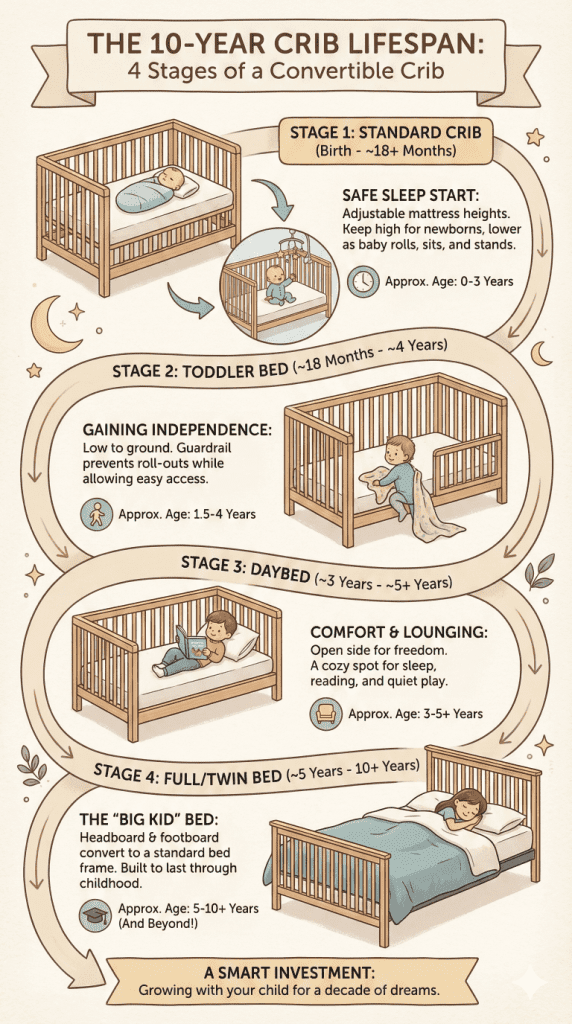
A convertible crib is designed to transform into multiple bed types as your child grows. Instead of buying new furniture every few years, you’re supposedly buying one piece that adapts through every stage.
Here are the main types:
3-in-1 Convertible Crib:
- Crib (birth to age 2-3)
- Toddler bed (age 2-5)
- Daybed (age 5-10+)
4-in-1 Convertible Crib:
- Crib (birth to age 2-3)
- Toddler bed (age 2-5)
- Daybed (age 5-7)
- Full-size bed (age 7-12+)
5-in-1 Convertible Crib: (Less common)
- Adds a twin bed option between daybed and full bed
How conversion works: You remove the crib rails, add or remove side panels, and attach different rail kits (toddler rail, full-size bed rails) to transform the structure. The headboard and footboard usually stay the same throughout all configurations.
Typical price range: $300-1,200
Theoretical lifespan: 10-12 years (if you use all conversions)
Common brands: Babyletto, DaVinci, Delta Children (premium lines), Storkcraft, Pottery Barn Kids
Sounds amazing, right? One purchase, a decade of use. But here’s where it gets complicated.
Warning: Don’t confuse ‘Convertible’ with ‘Mini.’ A Convertible Mini Crib requires a special mini mattress and won’t last as long as a standard-sized convertible crib. Always check the mattress dimensions: Standard is approx. 28″ x 52″.
The Real Cost Analysis: Breaking Down Every Dollar
This is where we get into the math that salespeople conveniently skip. Because when you actually add up ALL the costs—not just the initial crib purchase—the numbers tell a very different story.
Standard Crib Total Cost (Birth to Age 10)
Let’s map out what you’ll actually spend if you go the standard crib route and buy new furniture as your child grows:
Initial purchase (Year 0-1):
- Standard crib: $150-300
- Crib mattress: $150-200
- Subtotal: $300-500
Toddler transition (Year 2-3):
- Toddler bed: $100-200
- Toddler mattress: $80-120
- Subtotal: $180-320
Big kid bed (Year 5-7):
- Twin or full bed frame: $200-400
- Twin/full mattress: $200-400
- Subtotal: $400-800
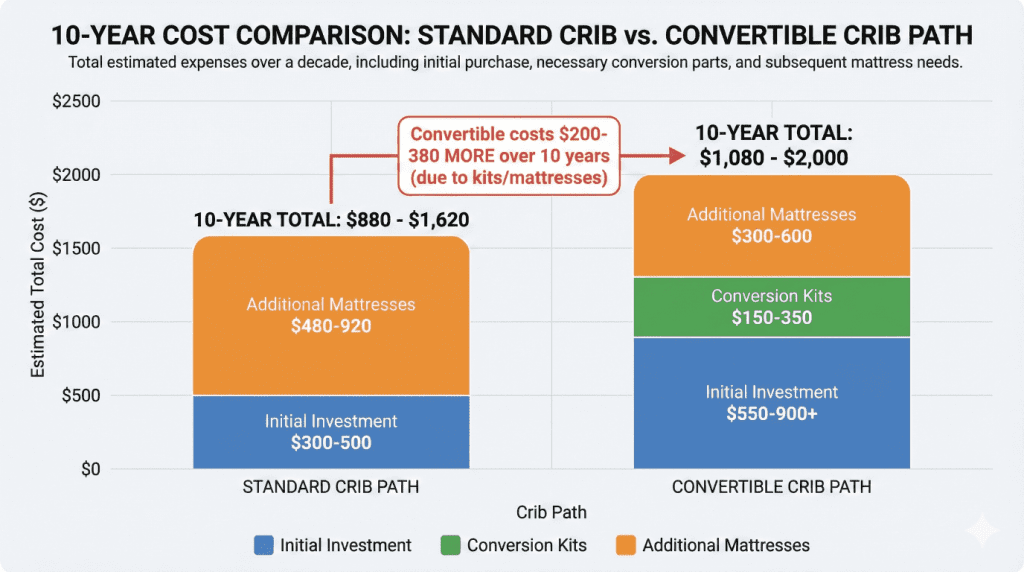
TOTAL COST OVER 10 YEARS: $880-1,620
Convertible Crib Total Cost (Birth to Age 10)
Now let’s look at the convertible route with ALL the actual expenses:
Initial purchase (Year 0-1):
- 4-in-1 convertible crib: $400-700
- Crib mattress: $150-200
- Subtotal: $550-900
Toddler conversion (Year 2-3):
- Toddler bed conversion kit: $50-150 (NOT included with most cribs!)
- Toddler bed rail guards: $30-50
- Subtotal: $80-200
Full-size conversion (Year 7-8):
- Full-size bed conversion kit: $100-200 (Also sold separately!)
- Full-size mattress: $300-600
- Full-size bedding (sheets, comforter): $50-100
- Subtotal: $450-900
TOTAL COST OVER 10 YEARS: $1,080-2,000
The Cost Comparison Reality Check
Here’s the truth bomb: Convertible cribs often cost MORE over time when you factor in all the conversion kits, additional mattresses, and the higher upfront cost.
| Expense Category | Standard Crib Path | Convertible Crib Path | Difference |
| Initial Investment | $300-500 | $550-900 | +$250-400 |
| Conversion Kits | $0 | $150-350 | +$150-350 |
| Additional Mattresses | $480-920 | $300-600 | Standard higher |
| 10-Year Total | $880-1,620 | $1,080-2,000 | Convertible costs $200-380 MORE |
Key insight: The “buy once, use forever” promise only saves money if:
- You only have one child (or space kids 5+ years apart)
- You buy ALL conversion kits at time of purchase
- You actually use the crib through all conversion stages
- The conversion kits remain available when you need them
That last point? That’s where most families run into problems.
Convertible Crib Pros and Cons: The Unfiltered Truth
Let’s talk about what the marketing materials promise versus what actually happens in real life.
The Pros of Convertible Cribs
✅ One piece of furniture through multiple life stages
In theory, you shop once and you’re done. No browsing toddler beds at Target when you’re exhausted. No measuring bedrooms for new furniture. The crib you set up in the nursery transforms as your child grows.
For parents who hate furniture shopping or decision fatigue, this is genuinely appealing.
✅ Aesthetic consistency
The nursery you carefully designed maintains its look. The furniture “grows” with the room rather than being replaced with mismatched pieces. If you invested in a cohesive design, this matters.
✅ More environmentally friendly
Less furniture ending up in landfills. Reduced consumption. One piece lasting 10+ years instead of three separate pieces lasting 3-4 years each. For eco-conscious families, this is a real benefit.
✅ Potential cost savings for one-child families
If you’re one-and-done AND you successfully navigate all the conversions, you can save $200-500 compared to buying separate furniture. The keyword here is “if.”
✅ Sentimental value
Some parents love the idea of their child sleeping in the “same bed” from infancy through childhood. It can feel meaningful to keep that one piece of furniture through so many milestones.
The Cons of Convertible Cribs (What Salespeople Don’t Mention)
❌ Conversion kits are frequently discontinued
This is the #1 complaint I see in every parenting group. You buy the crib when your baby is born. Three years later, you’re ready to convert it to a toddler bed. You go to order the conversion kit and discover:
- The finish has been discontinued
- The model has been replaced
- The company changed manufacturers
- The kit is sold out everywhere
I’ve seen parents desperately searching Facebook Marketplace, eBay, and brand-specific resale groups, willing to pay 2-3x retail for an out-of-stock conversion kit. Many end up buying a new bed anyway, making the entire “convertible” feature pointless.
The solution: Buy ALL conversion kits at the time you buy the crib. Yes, that’s an extra $150-350 upfront. But it’s the only way to guarantee you’ll actually be able to convert it later.
❌ Much higher upfront cost when you’re already hemorrhaging money
The newborn phase is the most expensive time financially. Diapers, formula or pumping supplies, childcare deposits, medical bills—it all adds up fast. Spending an extra $300-400 on a crib “for the future” might not make sense when you need that money NOW for immediate expenses.
A $200 standard crib does the exact same job as a $600 convertible for the first 2-3 years. You can always reassess your furniture budget when your child is older and your financial situation is clearer.
❌ You’re locked into the same aesthetic for 10+ years
That modern mid-century crib that looks perfect in your Instagram-worthy nursery? Your 10-year-old might hate it. Design trends change. Kids develop their own tastes. What feels timeless when you’re decorating a nursery might feel dated or babyish years later.
Many parents I know who bought convertibles ended up buying different beds anyway because their child wanted something that reflected their personality—sports themes, princess canopies, gaming setups, whatever.
❌ Doesn’t work if you have kids close together
If you’re planning kids 2-4 years apart, you’ll need the crib again for baby #2 before you’d convert it for child #1. This completely defeats the purpose.
You’d be better off buying a $200 standard crib you can reuse for multiple children than a $600 convertible that sits unused as a toddler bed while you need the crib back.
❌ Converted beds often look awkward
I’m just going to say it: a lot of convertible cribs look weird in their later configurations. Toddler beds converted from cribs are often bulkier than standalone toddler beds (because they’re designed as cribs first). Full-size conversions sometimes have odd proportions—the headboard might be too tall or too wide for the mattress size.
They work functionally, but aesthetically? Not always great.
❌ Kids often want a “real” big kid bed anyway
By age 7-8, most kids want to pick out their own bed. It’s a milestone. Letting them choose a bed that reflects their interests (dinosaurs, unicorns, race cars, whatever) is exciting for them.
Sticking with the converted crib because “we paid for it to last until age 12” might make financial sense, but it takes away that experience from your child.
When a Standard Crib Makes More Sense
Standard cribs get a bad rap as the “budget” option, but there are plenty of scenarios where they’re actually the smarter choice—regardless of your budget.
You’re Planning Multiple Kids Within 2-4 Years
This is the biggest one. If you’re having kids relatively close together, you’ll need the crib again before you convert it.
Example: Your first child is 2.5 years old and ready for a toddler bed. You’re pregnant with baby #2. If you have a convertible crib, you’d need to convert it to a toddler bed AND buy a second crib for the new baby. You’ve now bought two cribs anyway.
If you’d bought a standard crib from the start, you’d use it for child #1, then reuse it for child #2, and potentially child #3. You’ll get way more value from a $200 standard crib used three times than a $600 convertible used once.
Your Budget Is Tight Right Now
There’s zero shame in buying the $150 crib when you need to save money for other essentials. A standard crib from IKEA or Graco meets the exact same safety standards as a $700 convertible.
You can always upgrade to nicer furniture later when finances improve. But spending an extra $400 on a crib when you’re stressed about covering childcare costs? That doesn’t make sense.
You Value Flexibility and Enjoy Furniture Shopping
Some parents actually like shopping for new furniture as their kids grow. They enjoy letting their toddler pick out a “big kid bed” and making it an exciting milestone.
If you’re someone who likes refreshing your home decor or doesn’t want to commit to one piece for a decade, standard cribs give you that flexibility.
You’re Renting or Moving Frequently
Standard cribs are often lighter, simpler to disassemble, and easier to move than convertible cribs with all their additional hardware and conversion pieces.
If you’re military, in temporary housing, or just planning to move in the next few years, having less complicated furniture makes life easier.
You Want Better Resale Value
Here’s something interesting: standard cribs in good condition hold their resale value pretty well. You can often sell a standard crib for 40-50% of what you paid.
Convertible cribs? Much harder to sell. Buyers need the conversion kits too, which are often unavailable. You’re essentially selling a crib that can’t actually convert, making it less appealing to secondhand buyers.
Pro Tip: Want to maximize resale value? Buy a fabric teething guard immediately. Babies will chew on the top rail when they start teething. A $20 crib rail cover protects the wood finish so you can sell the crib for top dollar later (plus, it’s safer for baby’s gums!).
[ALSO READ: Buying a Used Crib? How to Sanitize, Paint, and Safety-Check Second-Hand Gear]
When a Convertible Crib Makes More Sense
Convertible cribs aren’t inherently bad—they’re just not universally the right choice. Here’s when they actually make sense:
You’re Having Only One Child (Or Spacing Kids 5+ Years Apart)
If you’re one-and-done or your kids will be far enough apart in age that the first child will be done with the crib before the next one needs it, convertible cribs can genuinely save money and effort.
You’ll use the crib, convert it to a toddler bed, and potentially use it through the full-size bed stage. That’s 10+ years of use from one piece of furniture. The math actually works in your favor here.
You’re Willing to Buy ALL Conversion Kits Immediately
I cannot stress this enough: If you buy a convertible crib, buy every conversion kit at the same time.
Don’t wait. Don’t think “I’ll get it when I need it in three years.” By then, it might not exist.
Budget an extra $150-350 at purchase for the toddler rail kit and full-size conversion kit. Store them in the original packaging with your assembly instructions. Write the purchase date on the box. Keep the receipt.
This is the ONLY way to guarantee you’ll actually be able to convert your crib.
You Want to Minimize Future Furniture Shopping
If you genuinely hate shopping for furniture—the research, the comparing, the decision fatigue—a convertible crib eliminates 2-3 future shopping trips.
One decision in year zero, and you’re done (assuming you bought the conversion kits). For some parents, that peace of mind is worth the extra cost.
You Love the Aesthetic and Want Long-Term Consistency
If you’ve invested significant time and money into a cohesive nursery design, keeping the same furniture as it converts maintains that look.
Some high-end nursery furniture is genuinely beautiful—architecturally interesting, well-crafted pieces that look good in any configuration. If you found one you truly love, converting it can make sense.
Sustainability Is a Priority
If reducing consumption and waste is important to your family values, convertible cribs align with that.
One piece of furniture lasting 10+ years has a smaller environmental footprint than three separate pieces that each last a few years. You’re willing to pay more upfront because the long-term impact matters to you.
The Conversion Kit Problem: What No One Tells You

Let me tell you about my friend Sarah. She bought a beautiful Babyletto Hudson 3-in-1 convertible crib in “Grey” when her daughter was born. The crib was perfect—safe, sturdy, exactly what she wanted.
Three years later, her daughter was climbing out of the crib. Time to convert to a toddler bed. Sarah went to order the conversion kit and discovered the “Grey” finish had been discontinued. The new color was “Gray Wash,” which was completely different. The conversion kit in the original Grey? Sold out everywhere. Discontinued.
She found one on eBay for $175 (it originally retailed for $75). She paid it, frustrated but desperate. Then, two years later, she wanted to convert to the daybed. Guess what? Same problem. No kits available anywhere.
She ended up buying a twin bed from IKEA for $150 and selling the crib on Facebook Marketplace at a loss. Total waste of the “convertible” feature she’d paid extra for.
This story is not unique. I see versions of it constantly.
Why Conversion Kits Get Discontinued
Companies change manufacturers: The factory that made the crib in 2022 might not be the factory making parts in 2025. Slight variations in measurements mean old kits don’t fit new production.
Finishes get updated: “White” becomes “Warm White.” “Espresso” becomes “Weathered Espresso.” Even tiny color differences are noticeable, so old kits won’t match.
Models get replaced: Furniture companies introduce new lines every 2-4 years. Old models quietly get discontinued, and with them, the conversion kits.
Small brands go out of business: Especially true for boutique nursery brands. They close, and suddenly no one is manufacturing parts for their cribs.
How to Protect Yourself
If you’re buying a convertible crib, here’s your non-negotiable checklist:
- Buy ALL conversion kits at the time of crib purchase – I don’t care if it’s an extra $300. Buy them now.
- Store in original packaging – Keep them in a closet or garage in the original box with all hardware
- Keep the receipt with the packaging – You might need it for warranty issues
- Register the product with the manufacturer – This puts you on their list for recall notices and updates
- Take photos of the model number, serial number, and color name – Store these in your phone
- Join brand-specific Facebook groups – These often have resale markets for discontinued parts
What If You Already Have a Convertible Without the Kit?
If you’re reading this and thinking “Oh no, I already bought a convertible and didn’t get the kit,” here’s what to do:
Step 1: Check the manufacturer’s website directly
Step 2: Call customer service and ask if they have any old stock
Step 3: Search Amazon, eBay, Walmart, Target, Buy Buy Baby
Step 4: Join Facebook groups for your crib brand (DaVinci Owners, Babyletto BST groups, etc.)
Step 5: Search Craigslist and Facebook Marketplace for people selling unused kits
Step 6: Consider DIY conversion—hire a carpenter to custom-build a rail that works
Last resort: Accept that the conversion won’t happen and buy a new bed. Frustrating, but sometimes it’s the only option.
The Verdict: Should You Buy a Convertible or Standard Crib?
After all this analysis, here’s my honest recommendation based on different scenarios:
Choose a Standard Crib If:
☑️ You’re having multiple kids within 2-4 years – Reuse the same crib instead of converting
☑️ Budget is tight right now – Save the extra $300-400 for other essentials
☑️ You like flexibility – Enjoy picking new furniture as your child grows
☑️ You move frequently – Simpler furniture is easier to relocate
☑️ You want better resale value – Standard cribs sell more easily secondhand
☑️ You’re unsure about family size – Make decisions as you go rather than committing now
My top recommended standard cribs:
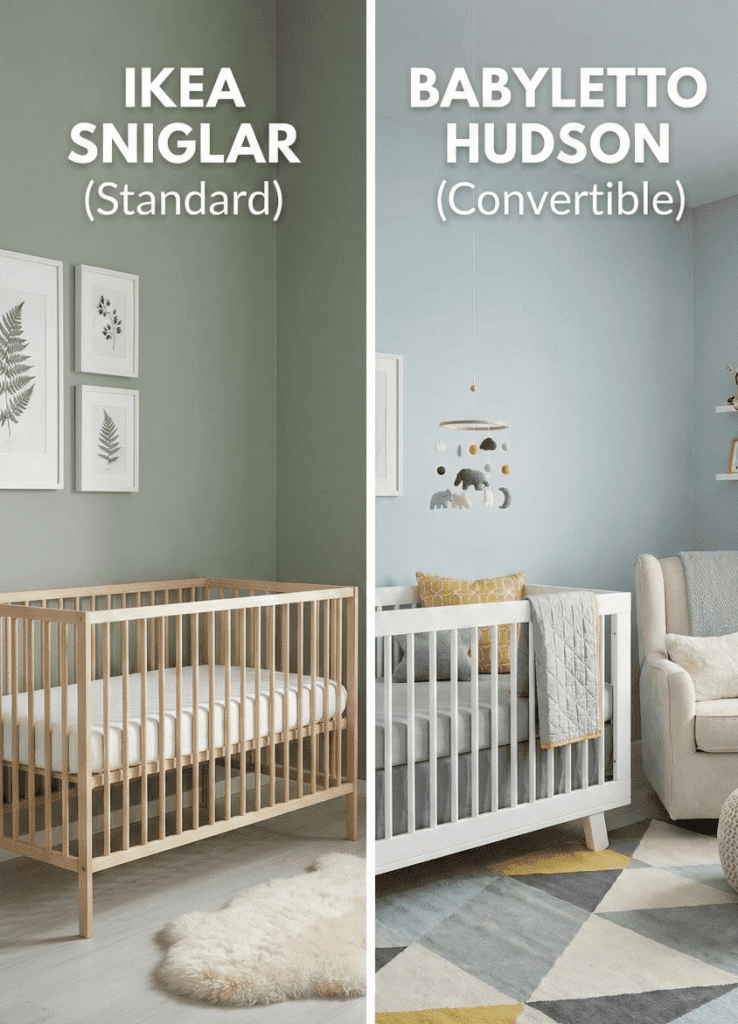
- IKEA SNIGLAR ($129) – Best budget option, solid beech wood, simple assembly
- Graco Benton 4-in-1 Convertible ($210) – Actually affordable enough to be worth converting
- Dream On Me Synergy ($150) – Great mid-range option with 5-star safety ratings
Choose a Convertible Crib If:
☑️ You’re having one child (or spacing kids 5+ years apart) – You’ll use all the conversions
☑️ You can buy ALL conversion kits upfront – Non-negotiable if going convertible
☑️ You want one piece of furniture long-term – Hate shopping for new furniture
☑️ Sustainability matters to you – Reducing waste is worth the extra cost
☑️ You’re committed to the aesthetic – Love the design and want to keep it for years
My top recommended convertible cribs:
- DaVinci Kalani 4-in-1 ($280) – Best budget convertible, widely available conversion kits
- Babyletto Hudson 3-in-1 ($399) – Mid-range, reliable brand, good resale
- Storkcraft Equinox 3-in-1 ($250) – Solid construction, affordable conversion kits
The Hybrid Approach (What I Actually Recommend)
Here’s what I think makes the most sense for most families:
Buy a standard crib now. Reassess in 2-3 years when you have more information.
When you’re pregnant with your first child, you don’t know:
- If you’ll have more kids
- How close together they’ll be
- What your financial situation will be in three years
- What your child’s preferences will be
- If you’ll move or stay in the same home
Why lock yourself into a decision now when you can wait and make a more informed choice later?
Buy a standard crib that meets all safety standards. Use it for 2-3 years. When your child is ready for a toddler bed, reassess:
- Can you afford something nicer now?
- Are you having more kids who need the crib?
- What does your child want?
You’ll have more information, more financial clarity, and the ability to make a better decision for your actual situation rather than your predicted situation.
[ALSO READ: The Ultimate Guide to Baby Cribs: How to Choose the Safe, Perfect Crib for Your Nursery]
Final Thoughts: Making the Right Choice for YOUR Family
Here’s the bottom line on the convertible vs. standard cribs debate: there’s no universal “right” answer that works for every family.
The $600 convertible crib isn’t inherently better than the $200 standard crib. They both keep your baby safe. They both meet federal safety standards. The difference is entirely about what happens AFTER the crib stage—and whether the “convertible” feature actually delivers value for your specific situation.
If I could give you just one piece of advice, it would be this: Don’t let marketing pressure you into spending more than you’re comfortable with right now. The best crib is the one that’s safe, fits your budget, and makes sense for your family’s actual plans—not your hypothetical future.
Buy what works for TODAY. You can always reassess when you have more information.
And if you’re still overwhelmed by all the options? Start with a standard crib. It’s the path of least regret. You’ll save money upfront, maintain flexibility, and avoid the conversion kit nightmare entirely.
Your baby will sleep just as soundly in a $150 standard crib as they would in a $700 convertible. I promise. Now go make a decision, stop second-guessing yourself, and get back to the other 47 things on your baby prep list. You’ve got this.
Is a 4-in-1 convertible crib worth the money?
It depends on your family situation. A 4-in-1 convertible crib is worth it if you’re having one child, can buy all conversion kits upfront, and will use it through all stages (10+ years). It’s NOT worth it if you’re having multiple kids close together, can’t afford the conversion kits now, or value flexibility in furniture choices as your child grows.
What’s the difference between a 3-in-1 and 4-in-1 convertible crib?
A 3-in-1 crib converts to a toddler bed and daybed. A 4-in-1 adds a full-size bed conversion. The 4-in-1 costs more upfront ($50-200 extra) and requires an additional conversion kit ($100-200). If you’ll use the full-size conversion, it’s worth it. If not, save the money with a 3-in-1.
Can you convert a standard crib into a toddler bed?
No. Standard cribs are not designed to convert. Once your child outgrows a standard crib, you’ll need to purchase a separate toddler bed (typically $80-200).
How long can you actually use a convertible crib?
As a crib: 2-3 years (until age 2-3 or 35″ tall). Fully utilized through all conversions: 8-12 years. However, many families transition to a different bed around age 7-8 when kids want to pick their own furniture, so real-world usage is often shorter than the 12-year potential.
Do convertible cribs come with the conversion kit?
Usually NO. Most convertible cribs require separate purchase of conversion kits. The toddler rail kit costs $50-150, and the full-size conversion kit costs $100-200. Always verify what’s included before purchasing. Never assume the kits are included.
Are convertible cribs harder to assemble than standard cribs?
Not necessarily. Assembly difficulty depends on the brand and model, not whether it’s convertible. Check reviews for specific models. Some convertible cribs are simple (30-60 minutes), while others are complex (2+ hours). The conversion process itself is usually straightforward—removing rails and attaching new ones.
Can I buy a conversion kit later if I didn’t buy it with the crib?
Technically yes, but it’s risky. Conversion kits are frequently discontinued 2-3 years after the crib model is released. If you didn’t buy the kit at purchase, you may not be able to find it later. This is the #1 complaint about convertible cribs. Always buy conversion kits at the time of crib purchase.
Is it better to buy a convertible crib or just buy separate beds?
For most families with multiple kids close together, buying separate beds (standard crib, then toddler bed, then twin bed) is more cost-effective and flexible. For one-child families or kids spaced 5+ years apart, a convertible crib that’s fully utilized can save $200-400 and reduce furniture shopping trips.