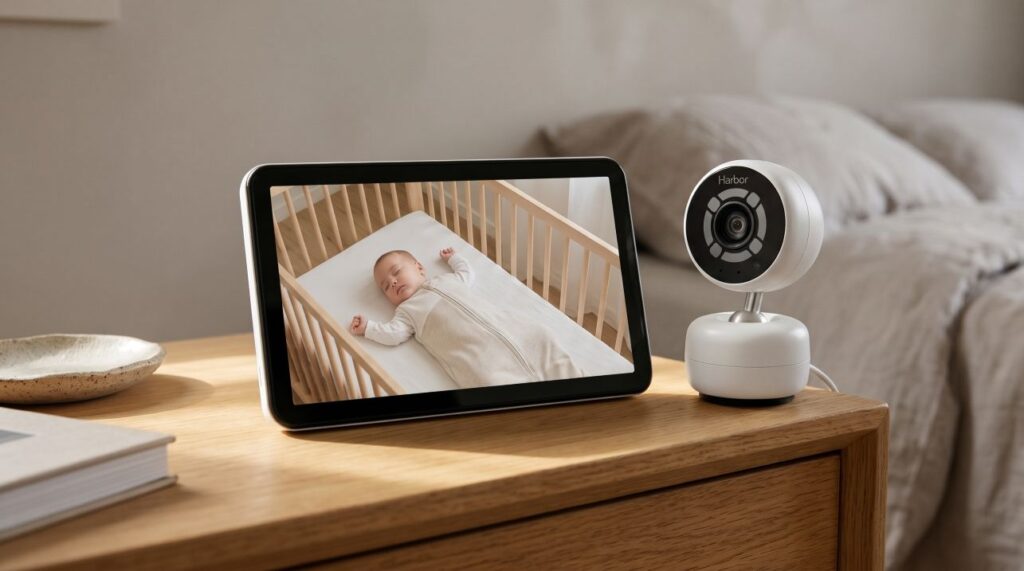
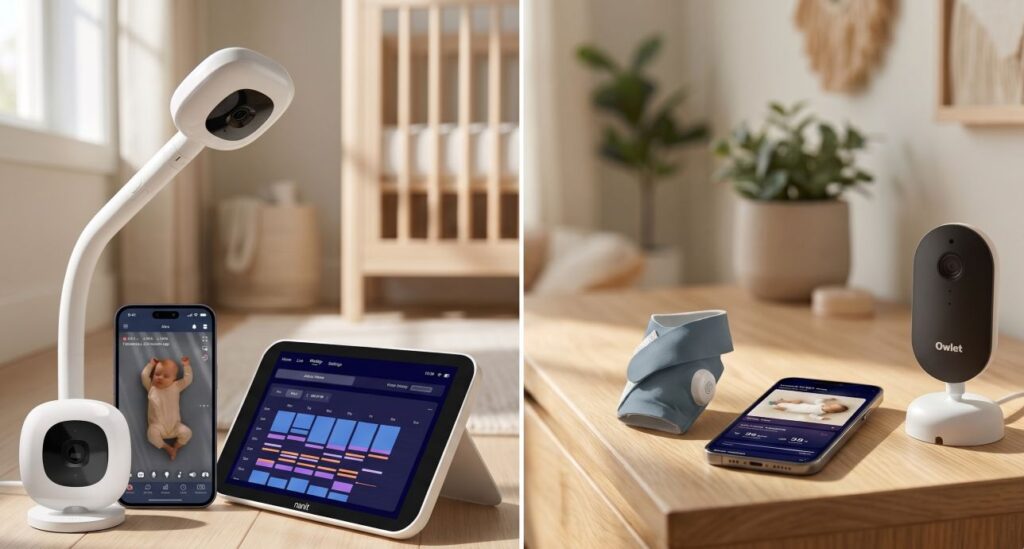
Parents comparing smart nursery monitors generally narrow their shortlist to two flagship systems from our guide to the Best Baby Monitors of 2026: the Nanit Pro Smart Baby Monitor and the Owlet Dream Duo 3. Both systems stream encrypted video to a smartphone app, monitor nursery temperature and humidity, and track infant physiology overnight. Let’s check what Nanit Pro vs. Owlet Dream Duo comparison brings up!
The two products gather physiological data through entirely different mechanisms. Nanit mounts an overhead 1080p camera above the crib and uses computer vision algorithms to read pixel movement on a patterned fabric Breathing Band, keeping electronics off the infant’s skin (Nanit Product Page). Owlet wraps an FDA-cleared optical pulse oximeter around the infant’s foot to measure live heart rate and blood oxygen saturation (SpO2) while pairing that data with a 2K HD video feed.
This technical comparison evaluates sensor accuracy, false-alarm triggers, mounting hardware, network security, and the two-year ownership cost of both systems.
Technical Specifications and Hardware Breakdown
Nanit Pro Smart Baby Monitor Specifications
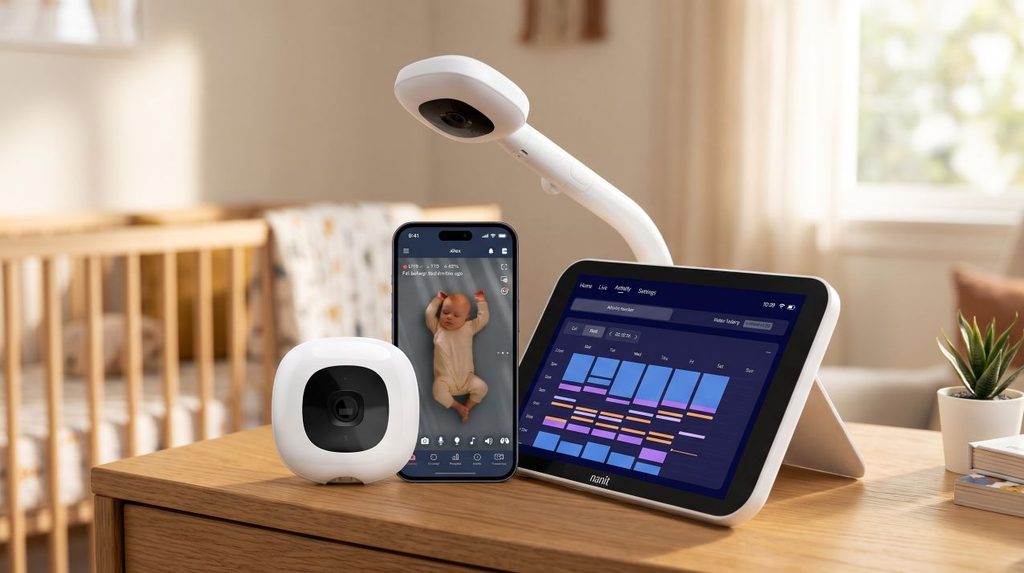
- Base Retail Price: $289.99 for the Pro Camera, Floor Stand or Wall Mount, one Small (0 to 3 month) sensor-free Breathing Band, and a 3-month trial of the Nanit Insights Sleep Plan; $399 when bundled with the dedicated 8-inch touchscreen display (Check Nanit Product on Amazon).
- Tracking Mechanism: Overhead computer vision reading geometric patterns on cotton Breathing Wear (Nanit).
- Physiological and Sleep Metrics: Respiratory motion in breaths per minute (RPM), sleep onset, night wakings, daytime nap duration, and overhead movement heatmaps (Nanit).
- Regulatory Classification: Consumer wellness and sleep-tracking monitor.
- Camera Resolution and Wireless Band: 1080p HD video over dual-band 2.4GHz and 5GHz Wi-Fi (Nanit).
- Security Architecture: Bank-grade end-to-end encryption with mandatory Multi-Factor Authentication (MFA) (Nanit).
- Subscription Tiers: After the included 3-month Sleep Plan trial, Nanit Insights costs $9 per month for the Sleep Plan, $10 per month for the Memories Plan, or $25 per month for the Milestones Plan (Nanit).
Owlet Dream Duo 3 Specifications
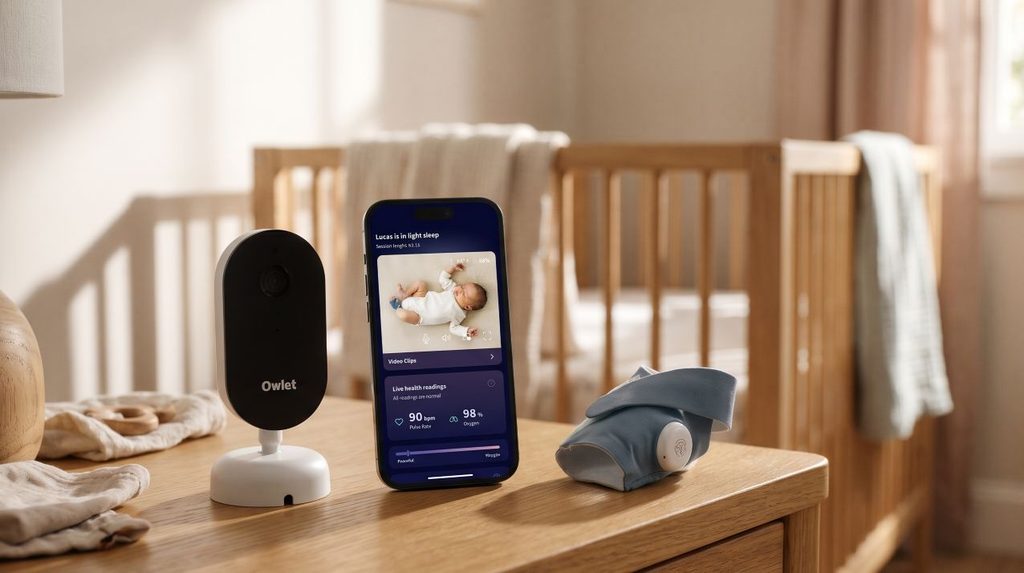
- Base Retail Price: $379.99 MSRP for the FDA-cleared Dream Sock, wireless charging base station, fabric socks in two sizes, and the 2K HD Dream Sight camera (Check Owlet Product on Amazon).
- Tracking Mechanism: Wearable foot-mounted pulse oximetry sensor transmitting via Bluetooth and 2.4GHz Wi-Fi (Owlet).
- Physiological and Sleep Metrics: Live pulse rate, arterial blood oxygen saturation (SpO2), wake windows, and sleep quality trends (Owlet).
- Regulatory Classification: FDA-cleared pulse oximetry system for live vital-sign monitoring (Owlet).
- Camera Resolution and Wireless Band: 2K HD video with a 130-degree wide-angle lens over 5GHz and 2.4GHz Wi-Fi plus Bluetooth setup (Owlet).
- Security Architecture: 256-bit encryption with elliptic curve authentication (Owlet).
- Subscription Tiers: Live pulse rate, SpO2 alerts, base station alarms, and standard video streaming operate without a subscription; extended clip storage and daily comparative reports are available via the optional Owlet360 plan.
Vital and Breathing Tracking: Computer Vision Versus Wearable Pulse Oximetry
Selecting between these two leaders from our 7 Best WiFi Baby Monitors of 2026 roundup depends on whether you want optical motion analysis or clinical blood-oxygen telemetry.
How the Nanit Pro Tracks Breathing Motion Without Skin Contact
The Nanit Pro positions its camera directly above the crib mattress on a Wall Mount or a 67-inch height-adjustable Floor Stand (Nanit Monitoring Page). The infant wears a 100% cotton Breathing Band or Nanit sleep sack printed with high-contrast black-and-white shapes. As the infant’s chest rises and falls, the overhead camera measures sub-millimeter pixel displacement across the fabric pattern from any angle (Nanit).
Because the fabric band contains zero wires, batteries, or transmitters, nothing electronic touches the infant’s skin. Parents never have to remember to place a wearable sensor on a charging dock each morning, and the band goes straight into the washing machine after a midnight spit-up. If the camera detects zero breathing motion for 20 seconds, both the camera unit in the nursery and the Nanit app on your phone sound an immediate alarm.
The optical approach carries two operational constraints. First, the camera requires a clear overhead view of the patterned band; if you swaddle the infant in a third-party blanket or travel without the stand, breathing motion tracking is unavailable. Second, optical tracking measures physical chest movement rather than blood oxygen saturation.
How the Owlet Dream Sock Measures Pulse Rate and Oxygen Saturation (SpO2)
The Owlet Dream Duo 3 uses hospital-style pulse oximetry, shining a safe light through the infant’s foot to calculate pulse rate and blood oxygen saturation (SpO2) continuously. The fabric wrap holds a small rechargeable sensor against the outer edge of the foot and sends readings to a bedside base station and the Owlet Dream App (Owlet).
If the infant’s heart rate or oxygen level moves outside preset clinical thresholds, the physical base station on your nightstand flashes and sounds an audible alarm even if your smartphone is in another room (Owlet). Because the sensor attaches to the foot, it continues tracking whether the infant sleeps in a bedside sleeper from our Bassinet Buying Guide, a full-size crib, or a travel play yard.
Wearable sensors introduce daily maintenance routines. The sock sensor requires daily charging on the base station and periodic wiping to prevent lotion or sweat buildup from degrading optical readings. Active infants who kick vigorously against crib slats can occasionally dislodge the sock placement, triggering a placement notification at 3 AM.
Regulatory Classification and AAP Safe Sleep Guidelines
Following regulatory evaluations of consumer infant monitors, the Owlet Dream Sock secured FDA clearance as an over-the-counter pulse oximetry monitor, validating its heart rate and SpO2 accuracy against clinical standards. The Nanit Pro operates as a consumer wellness and sleep-analytics device.
Regardless of FDA clearance, the American Academy of Pediatrics (AAP) 2022 Updated Recommendations state that home cardiorespiratory monitors do not reduce the risk of Sudden Infant Death Syndrome (SIDS) (AAP Safe Sleep Hub). Both monitors must be paired with the core environmental standards outlined in the HealthyChildren.org AAP Safe Sleep Guide:
- Place the infant on their back for every nap and nighttime sleep until age one (MO Safe Sleep AAP Summary).
- Use a firm, flat, non-inclined sleep surface that meets CPSC Safe Sleep Standards, covered only by a tight-fitting sheet with zero pillows, bumpers, or loose blankets (NJAAP Guidelines).
- Practice room-sharing without bed-sharing for at least the first six months (HealthyChildren.org; 10 Best Bedside Sleepers for C-Section Moms).
- Install all camera housings and electrical cords at least 3 feet away from the crib or bassinet perimeter to eliminate strangulation hazards (AAP Cord Strangulation Warning; MacroBaby Guide).
Camera Resolution, Mounting Options, and Network Security
Nanit Pro 1080p Overhead Mounts and Multi-Factor Authentication
The Nanit Pro captures 1080p HD video and includes an ASTM-certified cord cover kit to keep cables flush against the wall (Nanit). Its Floor Stand reaches 67 inches in height with a 12-inch base footprint, allowing renters to position the lens directly over a bassinet or crib without drilling into drywall (Nanit Monitoring Page).
On the software side, Nanit streams continuous background audio even when your phone screen is locked or running other apps, and it enforces mandatory Multi-Factor Authentication (MFA) to block credential-stuffing attacks detailed in our guide on Are WiFi Baby Monitors Safe? (Nanit). For parents who want a physical bedside screen alongside the smartphone app, Nanit offers a $399 bundle that includes a dedicated 8-inch touchscreen parent unit.
Owlet Dream Sight 2K Camera and 256-Bit Encryption
The Owlet Dream Duo 3 upgrades video clarity with the 2K HD Dream Sight camera, which offers a 130-degree wide-angle lens, clean infrared night vision, room temperature and humidity tracking, and automatic video clip capture triggered by sound, motion, or vital-zone alerts.
Owlet pairs the Dream Sight camera over 5GHz and 2.4GHz Wi-Fi using Bluetooth-assisted onboarding, securing video and health data with 256-bit encryption and elliptic curve authentication (Owlet). Because the Dream Sight mounts on a compact magnetic base or wall bracket rather than an overhead floor stand, it packs into a diaper bag quickly when visiting grandparents.
Two-Year Total Cost of Ownership (Hardware, Wearables, and Subscriptions)
Both systems qualify for purchase with HSA and FSA pre-tax healthcare funds. However, ongoing software and accessory costs diverge over a 24-month nursery timeline (covering the full span from newborn bassinet through our Bassinet to Crib Transition Guide).
- Nanit Pro 24-Month Cost ($479 to $814+): Starts at $289.99 for the camera and Floor Stand (or $399 with the 8-inch display), which includes one 0 to 3 month Breathing Band and a 3-month Sleep Plan trial. Continuing sleep analytics for the remaining 21 months adds $189 on the Sleep Plan ($9 per month), $210 on the Memories Plan ($10 per month), or $525 on the Milestones Plan ($25 per month), plus $20 to $60 for larger Breathing Bands or sleeping bags as the infant grows (Nanit). Note that basic live video and breathing-motion alerts with Breathing Wear still function if you decline the paid Insights plan.
- Owlet Dream Duo 3 24-Month Cost ($379.99 baseline): Starts at $379.99 and includes fabric socks sized for infants up to 18 months (or 30 pounds) along with live pulse rate, oxygen tracking, and 2K video streaming at $0 per month. Parents only pay extra if they opt into the Owlet360 subscription for extended cloud video storage and daily trend reports.
Alternative Hybrid and Non-Wi-Fi Options
Both the Nanit Pro and the Owlet Dream Duo rely on a functioning Wi-Fi router for smartphone streaming. If your home suffers from Wi-Fi dead zones, or if you want a system that operates without internet access during travel, review our analysis of the WiFi vs Non WiFi Baby Monitor category:
- For a hybrid local and cloud monitor: See our hands-on Harbor Baby Monitor coverage, which pairs a 10-inch local screen with remote app access and 24-hour video rewind at zero monthly fee.
- For a closed-circuit non-Wi-Fi monitor: See our 5 Best Non WiFi Baby Monitors of 2026 or our Best Camping Baby Monitor picks for battery-powered off-grid trips.
Frequently Asked Questions
Can you use the Nanit Pro without a monthly subscription?
Yes. Live 1080p video streaming, background audio, and real-time breathing motion alerts (when using Nanit Breathing Wear) function without a paid subscription (Fathercraft). A paid Nanit Insights plan ($9 to $25 per month after the 3-month trial) is required to view historical sleep logs, night-waking timelines, and saved video clips.
Is the Owlet Dream Duo 3 FDA-cleared?
Yes. The Dream Sock included in the Owlet Dream Duo 3 holds FDA clearance for tracking live pulse rate and oxygen saturation (SpO2) in infants.
Are the Nanit Pro and Owlet Dream Duo HSA and FSA eligible?
Yes. Both the Nanit Pro and the Owlet Dream Duo 3 can be purchased using HSA or FSA funds.
How far from the crib should the Nanit or Owlet camera be mounted?
Per the CPSC Safe Sleep Portal and AAP Cord Strangulation Warning, all cameras and power cords must be kept at least 3 feet away from any part of the crib or enclosed inside ASTM-certified rigid wall cord covers.
Summary Selection Criteria
Select the Nanit Pro if you want overhead sleep heatmaps, detailed wake-window analytics, an optional 8-inch dedicated touchscreen bundle, and breathing motion alerts that require zero electronic sensors on your infant’s skin.
Select the Owlet Dream Duo 3 if you want FDA-cleared pulse rate and blood oxygen (SpO2) readings, a physical bedside base station alarm, 2K camera resolution, and vital-sign tracking that transfers effortlessly between a bedside bassinet, crib, and travel play yard without mandatory monthly subscription fees.