
Determining exactly when to move baby to crib is a critical safety milestone that often causes anxiety for new parents. It allows for the proximity that reduces SIDS risk and makes those 3 AM feeds manageable. But as the months tick by, a new anxiety often creeps in: Is my baby actually safe in this small space anymore?
Moving the baby further away to a crib can feel like an emotional hurdle, but the decision shouldn’t be based on feelings. It is a decision rooted in physics and developmental milestones. As we detail in our Bassinet Buying Guide (2026): The Safest Options for Newborn Sleep, a bassinet is a medical safety device designed for a specific window of physiological vulnerability. Once your baby exceeds that window, the bassinet stops being a safety tool and starts becoming a risk.
When to Move Baby to Crib (The Short Answer)
The general rule of thumb suggests a transition between 4 and 6 months. However, this timeline is deceptive. While age is a guideline, physical milestones are the hard stops. Many infants physically outgrow the safety parameters of a bassinet well before the 6-month mark.
In 2022, the regulatory landscape shifted seismically with the CPSC’s strict enforcement of the Infant Sleep Product Rule, mandating that all sleep products meet rigorous safety standards previously reserved for cribs. This means “safety” is now a measurable engineering standard, not just a parenting style. If your baby has hit any of the following benchmarks, the time to transition is immediately—regardless of their age.
5 Critical Signs Your Baby Has Outgrown the Bassinet
Sign 1: The “Wingspan” Problem (Touching the Sides)
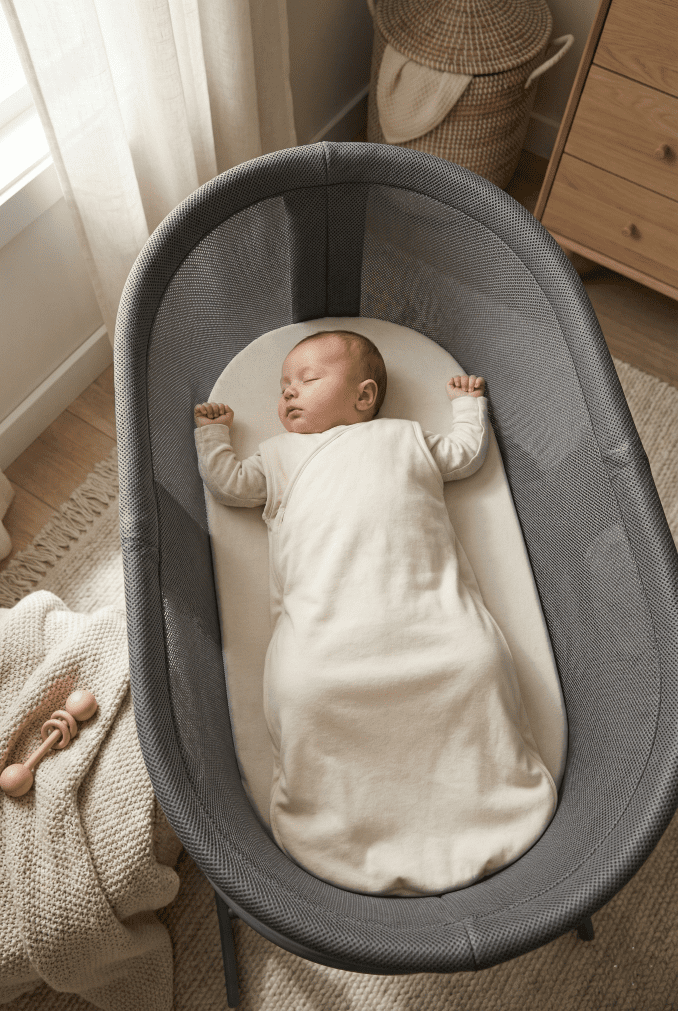
If you wake up to find your baby pressed against the mesh or waking up because their arms are hitting the sidewalls, the environment has become too restrictive. While high-quality bassinets feature mesh to allow for passive airflow and prevent CO2 accumulation, a cramped baby is an uncomfortable baby. More importantly, stringent safety standards mandate that lateral angles not exceed 7 degrees to prevent an infant from rolling into a corner and becoming entrapped against the sidewall.
Sign 2: The “1-Inch Rule” (Height Limits)

This is the most technical and often overlooked metric. You do not wait until your baby’s head touches the top of the bassinet. The safety transition is mandatory when the baby has less than 1 inch of clearance between their head or feet and the bassinet wall.
For taller infants, this clearance issue can arise as early as 4 months. Once that buffer zone is gone, the risk of injury from impact or entrapment increases.
Sign 3: The “Roller” (Mobility Milestones)
The moment your baby attempts to roll over, the safety dynamics of a bassinet change instantly.
- The Swaddle Stop: Rolling signals the immediate end of swaddling.
- The Space Constraint: A bassinet is often too shallow to safely accommodate a rolling baby. If they roll, they may face a fall risk or become wedged in a position they cannot escape.
- Note: Some smart sleepers like the SNOO have clipped-in swaddles that physically prevent rolling, allowing for a longer stay in the bassinet. For all other standard bassinets, the first roll is your eviction notice.
Sign 4: The Weight Limit (Read the Sticker)
Every bassinet has a structural weight limit. New testing protocols require bassinets to withstand significant off-center loading to prevent tipping, a risk that increases as an active infant shifts their weight.
Never assume your baby is “fine” because the frame looks sturdy. Exceeding the weight limit compromises the stability of the unit. You must verify compliance with specific standards to ensure the unit can handle the load without structural failure.
Sign 5: The “Pull-Up” Attempt
This is the absolute hard stop for bassinet use. The moment your baby can push up on their hands and knees, the bassinet is unsafe.
Bassinets have much shallower sidewalls than cribs. A baby pushing up on hands and knees has a higher center of gravity and can easily vault over the side, leading to a dangerous fall. This milestone often happens seemingly overnight, which is why experts emphasize moving to a crib immediately upon seeing this development.
The “Hidden” Danger: Mattress Softness & Tilt
Even if your baby fits within the size limits, the condition of the bassinet itself might signal it’s time to move on, especially if you are using a hand-me-down or an older model.
The Tilt Check
Modern safety standards (ASTM F2194-25) are incredibly strict about angles to prevent positional asphyxia—where a baby’s heavy head slumps forward, cutting off their airway.
- Head-to-Toe: The sleep surface must be ≤ 10 degrees from horizontal.
- Side-to-Side: The lateral angle must not exceed 7 degrees.
If your bassinet has developed a “tilt” over time—common in single-stem cantilever models like the Halo—it is no longer safe.
The Firmness Test: The “CD & Milk Carton” Method

Parents often worry a mattress is “too hard,” but softness is a suffocation risk. To objectively test if your bassinet mattress is still firm enough to be safe, use this field-validated test:
- The Apparatus: Gather 12 standard CDs (representing the surface area of a baby’s face) and two 1-liter (or quart) cartons of milk/juice (representing the weight of a baby’s head, approx. 2kg).
- The Setup: Wrap the stack of CDs tightly in plastic wrap and place them on the mattress. Place the two milk cartons on top of the CDs.
- The Evaluation: Look at the edge of the cartons relative to the mattress surface.
- Safe: The cartons sit level and do not sink significantly.
- Unsafe: The carton edge dips below the mattress surface level, or the mattress billows up around the CDs.
If the mattress fails this test, it is too soft to support your infant’s airway safely, and you must move to a crib immediately.
Pro Tip: This test can be performed with other stuff in your home as well if you don’t find a CD (I get it, it’s 2026 and I am writing about CDs). You can look for maybe a hard cover book (around 100 to 200 pages max).
What to Do Next

If you’ve checked the boxes above and realized the bassinet is no longer the safest option, don’t panic. You can make the switch to a crib safe immediately by ensuring the crib mattress is at its lowest setting if your baby is pulling up and keeping the sleep space bare—no pillows, blankets, or bumpers.
However, knowing when to move is only half the battle; knowing how to do it without wrecking your sleep schedule is the other.
Now that you have confirmed it is time to make the switch, you need a plan to ensure the move is tear-free and safe. For a detailed roadmap on handling the new room, the new mattress, and the routine changes, read our guide: How to Transition Your Baby from Bassinet to Crib: A Step-by-Step Sleep Training Guide.
Conclusion
The bassinet is a wonderful tool for the first few months, but it is a temporary one. Prioritizing the physics of safety over the convenience of bedside reach is the hallmark of informed parenting. If your baby has hit the 1-inch mark, started rolling, or the mattress has grown soft, the crib is not just the next step—it is the safest place for them to be.
FAQs
At what age should a baby move to a crib?
While the transition often happens between 4 and 6 months, you must move the baby immediately if they push up on hands and knees, roll over, or have less than 1 inch of clearance at their head or feet.
Can I keep using the bassinet if my baby rolls over?
No, rolling creates immediate fall and entrapment risks in shallow bassinets, so you must transition. The only exception is the SNOO Smart Sleeper, which uses a clipped-in swaddle to physically prevent rolling.
What is the “1-Inch Rule” for bassinet safety?
The “1-Inch Rule” is a mandatory safety check: if there is less than 1 inch of space between the baby’s head or feet and the bassinet wall, they have outgrown the unit and must transition to a crib.
My baby touches the sides of the bassinet. Is this unsafe?
Yes, it can be unsafe. While mesh allows airflow, pressing against the sides suggests the baby is too big, and lateral angles greater than 7 degrees can cause the infant to become entrapped against the wall.
How can I tell if my bassinet mattress is too soft?
Use the “CD & Milk Carton” test: Place two 1-liter milk cartons (approx. 2kg) on top of a stack of 12 CDs on the mattress. If the cartons sink or tilt, the surface is too soft and poses a suffocation risk.
My bassinet seems to tilt slightly. Is that okay?
No. To prevent positional asphyxia (airway blockage), safety standards require the head-to-toe sleep surface angle to be 10 degrees or less. If your bassinet exceeds this, it is unsafe.
Is it safe to use a second-hand bassinet?
Using a second-hand bassinet is risky because foam mattresses degrade and soften over time, increasing suffocation risk. Additionally, models manufactured before 2022 may not meet current structural stability and entrapment standards.
Can I add a softer mattress pad for comfort?
No. The CPSC warns against using any mattress not specifically provided by the manufacturer, as generic mattresses that are even slightly smaller can create deadly gaps where a baby can get trapped.
My baby pushes up on their hands and knees. Is the bassinet safe?
No. This milestone is a “hard stop” for bassinet use. A baby pushing up has a higher center of gravity and can easily vault over the shallow sides, creating a severe fall hazard.
What is the weight limit for a bassinet?
Most bedside bassinets have a weight limit of 15-20 lbs. It is critical to adhere to the manufacturer’s sticker, as exceeding this limit compromises the unit’s ability to withstand off-center loading without tipping.