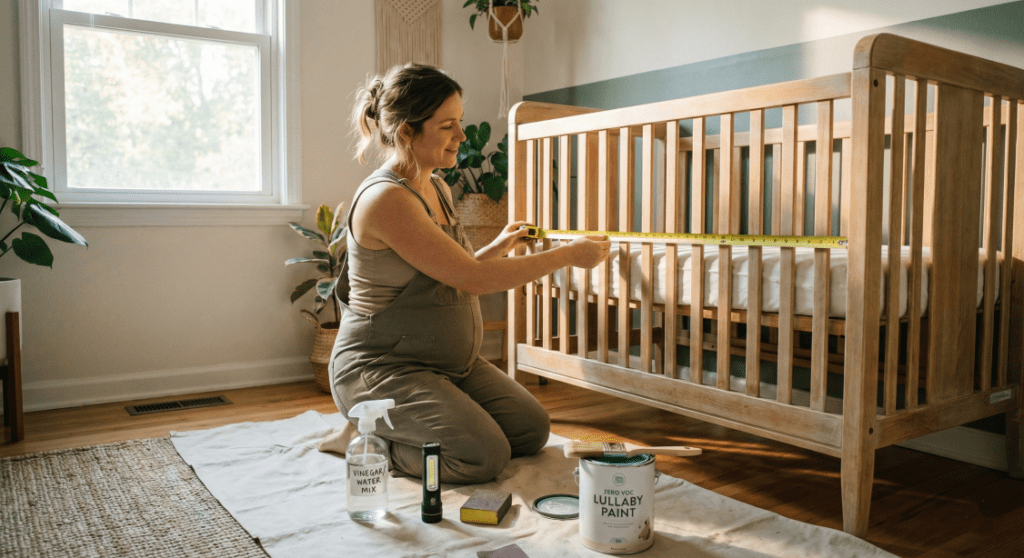
Buying a used crib is one of the smartest financial moves a new parent can make, but it is also one of the most stressful. You are navigating a landscape filled with conflicting advice, “survivorship bias” from relatives, and rigid safety warnings.
Let’s be real for a second: the “nesting” phase is a wild mix of emotions. On one hand, you’re pinning dreamy nurseries on Pinterest. On the other hand, you’re looking at your bank account and realizing that babies are expensive. I remember staring at a gorgeous mid-century modern crib online, seeing the $800 price tag, and immediately opening Facebook Marketplace to see if I could find something similar for $50.
For my eco-conscious mamas, buying a used crib is a beautiful way to participate in the “circular economy” and keep furniture out of landfills. But here is the hard truth I need you to hear as a mom and a researcher: A crib is not a dresser.
It is the only place where you will leave your helpless infant alone, unsupervised, for hours at a time. Unlike a stroller, where you are right there if a wheel wobbles, a crib failure can be silent and catastrophic.
This guide is your permission structure to buy used, but only if you follow these strict safety guardrails. We are going to bridge the gap between that beautiful vintage aesthetic and the non-negotiable requirements of infant safety.
[ALSO READ: The Ultimate Guide to Baby Cribs]
The Golden Rule: The June 28, 2011 Hard Stop
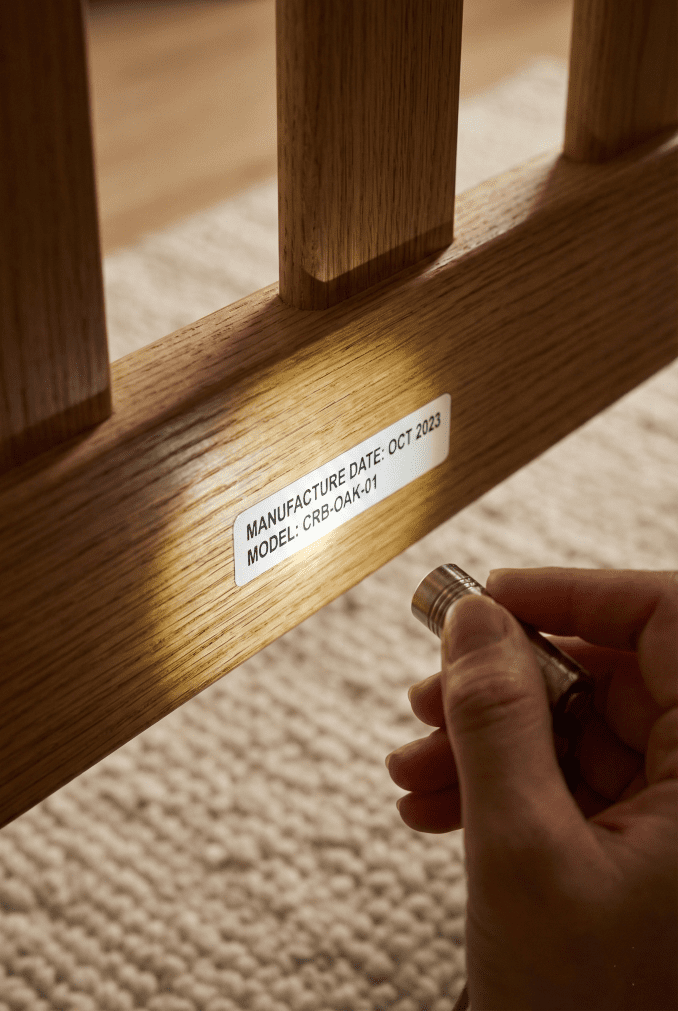
Before you even look at a photo or drive to a stranger’s house, you need to know one date.
⚠️ WARNING: The “Kill Date”
If a crib was manufactured before June 28, 2011, walk away. Do not buy it. Do not accept it as a gift. Do not try to fix it.
Why this specific date? This isn’t just an arbitrary suggestion. On this day, the Consumer Product Safety Commission (CPSC) implemented the most rigorous crib safety standards in the world (16 CFR 1219 and 1220).
Prior to 2011, safety standards were largely voluntary. The new law explicitly banned the manufacture and sale of drop-side cribs. These cribs were associated with at least 32 infant deaths between 2000 and 2010 due to hardware fatigue that created dangerous “V-shaped” gaps where babies could suffocate.
New Mamaa Rule: It is actually illegal to sell a crib that doesn’t meet these standards. If you see a thrift store refusing to take cribs, this is why.
[ALSO READ: Crib Safety Standards 101]
The “Immediate Dealbreakers” Checklist
Okay, so the crib was made in 2015. It’s safe, right? Not necessarily. Even modern cribs can have dangerous modifications or wear and tear.
When you are scrolling through listings or standing in a seller’s garage, use this binary checklist. If the crib has ANY of these features, it is unsafe.
| Feature | The Danger | The Rule |
| Drop-Side Rail | Hardware failure leads to entrapment gaps. | BANNED. No exceptions. |
| Slat Width > 2 3/8″ | A baby’s body can slide through, but their head can get trapped. | The Soda Can Test: If a standard soda can fits through the slats, it’s dangerous. |
| Corner Posts > 1/16″ | Catch points for clothing or pacifier ribbons (strangulation risk). | Posts should be flush with the end panel (unless they are canopy posts >16 inches). |
| Cutouts | Decorative cutouts in the headboard can trap limbs or heads. | Avoid “heirloom” designs with intricate cutouts. |
| Missing “Date” Label | You cannot verify recalls or age. | No label = No buy. |
[ALSO READ: Convertible vs. Standard Cribs]
How to Inspect a Used Crib (The “Boots on the Ground” Guide)
You’ve found a crib that passes the visual check. Now you need to inspect it like a pro. Sellers aren’t usually trying to scam you; they just often suffer from “survivorship bias” (“My kids slept in it and they are fine!”).
1. The Hardware Forensics: Barrel Nuts vs. The “Hack”
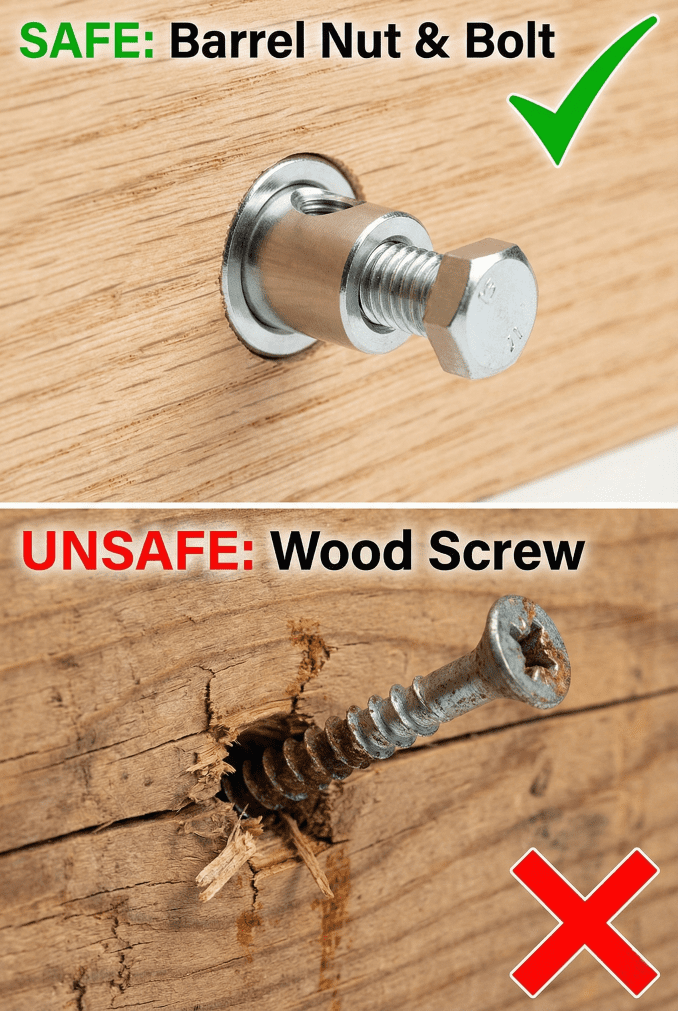
This is the most common failure point I see. Modern cribs usually use a Barrel Nut system—a metal cylinder that sits inside the wood and intersects with a bolt. These are super strong.
The Danger: When a seller loses a bolt, they might run to the hardware store and jam a standard wood screw into the hole. A wood screw does not have the shear strength to hold up a bouncing toddler.
What to look for: Check every joint. Do all the bolt heads match? If one looks like a pointed screw you’d use on a deck, the crib’s structural integrity is compromised.
[ALSO READ: Smart Cribs vs. Traditional Cribs]
2. The Physical “Shake Test”
Never buy a disassembled crib if you can avoid it. You cannot test stability on a pile of wood.
- The Method: Grip the top rail and give it a firm, rhythmic shake.
- The Diagnosis: A little rattle is okay (loose bolts). But if the crib “racks” (shifts its geometric shape like a parallelogram) or wobbles at the joints, the wood is likely stripped or cracked. That is unsafe and not fixable.
3. The Mattress Bracket “L” vs. “7”
This is a subtle error that scares me. Mattress brackets usually look like an “L” shape to cradle the mattress support. I’ve seen so many parents install them upside down (looking like a “7”). If your toddler jumps, that bracket can fail. Always check the manual!
Navigating Recalls Without the Box
“But Emily, I don’t have the box, so how do I know if it’s recalled?”
Great question. Federal law requires a permanent tracking label on the crib itself. It’s usually hidden to keep the crib looking pretty. Here is where to look for popular brands:
- IKEA: Check the underside of the top panel or the inside of the side panel. You are looking for a 5-digit supplier number and a date stamp (YYWW).
- Babyletto: Look on the inside of the right side panel (near the bottom) or on the mattress support slats.
- Delta / Pottery Barn: Usually on the inner bottom rail of the headboard.
The Verification Process:
- Snap a photo of the Model Number and SKU.
- Go to the CPSC Recall Database.
- Search the brand and model.
The Mattress Gap: The “Two-Finger” Rule
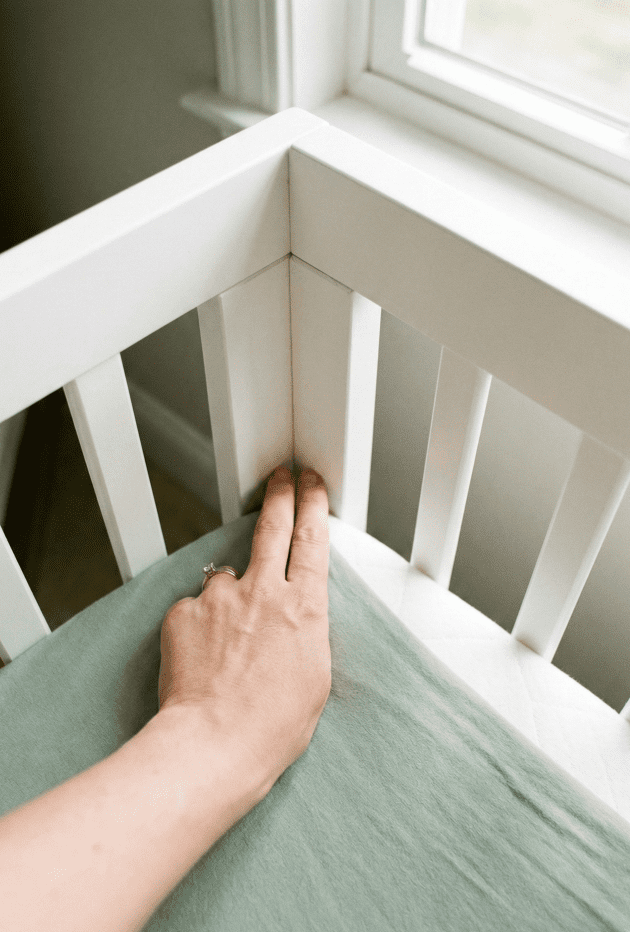
Here is where physics gets scary. Older cribs (even post-2011 ones) can warp, or their dimensions might be slightly “off” compared to modern standard mattresses.
The Rule: When the mattress is centered in the crib, the gap at the edge must not exceed 1/2 inch.
The Field Test: If you can fit more than two fingers between the mattress edge and the crib side, the gap is dangerous. An infant can roll into that crevice and suffocate.
My Advice: Always buy a new mattress. Used mattresses are a hygiene risk anyway, but buying new ensures you are getting the standard 27 1/4″ x 51 5/8″ size.
[ALSO READ: When to Lower the Crib Mattress?]
The DIY Restoration Guide: Hygiene & Chemistry

For my “Eco-Upcyclers” who view a used crib as a project—I love your energy! But we need to talk about chemistry. Refinishing a crib is not the same as refinishing a coffee table.
1. Biological Safety: Bed Bugs & Mold
Before you bring that crib into your home, inspect it for hitchhikers. Bed bugs love tight pressure, so they hide in screw holes and slat joints.
- Inspection: Use a flashlight. Look for “rusty” dots (fecal matter) or translucent skins (shed exoskeletons). If you see either, run. You cannot safely treat wood for bed bugs without chemicals that are too harsh for a baby.
For Mold: If the crib smells musty, examine the wood closely.
- The “Soft Wood” Test: If the wood feels soft or spongy to the touch, the mold is deep in the grain. This requires disposal, not cleaning.
- Surface Mold Recipe: If it’s just surface mold, use 50% White Vinegar and 50% Water. Vinegar penetrates the wood grain to kill mold roots better than bleach.
- The Secret Weapon: Dry it in direct sunlight. UV radiation is a potent natural disinfectant.
2. The “Vintage” Trap: Lead Paint
If you are eyeing a cute vintage crib from the 80s or 90s, be careful. Lead paint wasn’t just a 1970s problem; it can be found in pigments used much later.
- The Test: Use a 3M LeadCheck or D-Lead kit.
- The Trick: You must “score” the paint—cut a small “V” notch down to the wood. You need to test the bottom primer layer, not just the top coat.
- The Fix: If it tests positive, do not sand it. Sanding releases lead dust that is impossible to fully clean. Disposal is the only safe option.
3. Painting Safely: The “Curing” Time Trap
If you want to repaint, “Low VOC” isn’t good enough. You want Zero VOC. Look for paints that meet EN71-3 (European Toy Safety) or ASTM F963-17 standards. Brands like ECOS Paints or Lullaby Paints are great options.
The Critical “30-Day” Rule:
This is the number one mistake DIY parents make. Latex paint dries in hours, but it takes 30 days to cure.
- Dry: Solvent has evaporated enough to touch.
- Cured: The chemical chains have hardened and stopped off-gassing.
If you put a baby in a crib with uncured paint, they are breathing fumes, and the soft paint is easy to scrape off and eat. Plan your project so it’s finished at least one month before the baby arrives.
4. Natural Alternatives
If you prefer a natural look over paint, skip the oil-based polyurethanes. Instead, use 100% Hemp Oil or Beeswax (food grade) to seal raw wood or chalk paint safely.
[ALSO READ: The 10 Best Non-Toxic & Greenguard Gold Certified Cribs]
Frequently Asked Questions About Buying Used Cribs
Is it safe to buy a second-hand crib?
Yes, but only if it meets specific safety criteria. The most important rule is to ensure the crib was manufactured after June 28, 2011. Cribs made before this date likely do not meet current federal safety standards (16 CFR 1219) and should be avoided
Why are drop-side cribs considered dangerous?
Drop-side cribs were banned because their hardware is prone to fatigue and failure. If the hardware breaks, the side rail can detach, creating a “V-shaped” gap between the mattress and the side where an infant can become entrapped and suffocate.
How can I check if a used crib has been recalled if I don’t have the box?
You must find the permanent tracking label on the crib itself. On brands like IKEA, look on the underside of the top panel or inside the side panel. For Babyletto, check the inner lower side panel or mattress slats. Use the Model Number and Date from this label to search the CPSC Recall Database.
Can I use standard screws from the hardware store to replace missing crib parts?
No. This is a major safety risk. Most cribs use high-strength “barrel nuts” and machine bolts. Standard wood screws do not have the necessary shear strength to hold the crib together during use and can lead to structural collapse. Always order specific replacement parts from the manufacturer.
How do I disinfect a used wooden crib safely?
Avoid harsh chemicals like bleach, which can damage wood and linger on the surface. Instead, use a solution of 50% white vinegar and 50% water. Vinegar penetrates the wood grain to kill mold roots. After cleaning, let the crib dry in direct sunlight, as UV radiation is a natural disinfectant.
How do I test a vintage crib for lead paint?
Use an EPA-recognized test kit like 3M LeadCheck or D-Lead. Crucially, you must “score” the paint by cutting a small “V” notch down to the bare wood before testing. This ensures you are testing all layers of paint, not just the top coat, which might be covering older lead paint.
What kind of paint is safe for refinishing a crib?
Look for water-based acrylics or milk paints labeled “Zero VOC”. “Low VOC” is not sufficient. Ensure the paint meets EN71-3 or ASTM F963-17 standards, which certify that the paint is safe if a child chews on it (limiting toxic elements like cadmium and arsenic).
How long do I need to wait after painting a crib before my baby can sleep in it?
You should wait at least 30 days. While latex paint feels “dry” to the touch in hours, it takes a full month to “cure” (reach maximum hardness and finish off-gassing chemicals). Using it sooner exposes your baby to fumes and soft paint that is easily ingested.
How do I check a used crib for bed bugs?
Bed bugs are “thigmotactic,” meaning they seek tight pressure. Use a flashlight to inspect screw holes, joints, and mattress slats. Look for “rusty” black dots (fecal spots) or translucent skins. If you find any evidence, do not buy the crib, as wood is difficult to treat safely.
Is it okay to use the used mattress that comes with the crib?
It is strongly recommended to buy a new mattress. Aside from hygiene concerns, older mattresses or cribs may not fit perfectly. Use the “Two-Finger Test”: if you can fit more than two fingers (or 1/2 inch) between the mattress edge and the crib side, the gap is a suffocation hazard.
The New Mamaa Verdict
Buying a used crib is a labor of love. It requires patience, a critical eye, and a little bit of elbow grease.
The Final Checklist:
- Date Check: Post-June 2011? (Yes/No)
- Shake Test: Is it solid? (Yes/No)
- Hardware: Are the original barrel nuts present? (Yes/No)
- Finish: Is it lead-free and fully cured? (Yes/No)
- Mattress: Does it pass the two-finger test? (Yes/No)
If you can check all these boxes, congratulations! You just saved hundreds of dollars and kept a beautiful piece of furniture in circulation. If you have any doubts—even a tiny one—walk away. Your peace of mind is worth more than the savings.