If you are currently panic-scrolling through this bassinet buying guide at 2 AM, take a deep breath; you have found the only resource you need.
Let’s be honest: choosing where your baby sleeps isn’t just about buying nursery furniture. It is the acquisition of a medical safety device that will house your newborn for 14 to 16 hours a day. The market is flooded with options, and sometimes it’s hard to know if you even need a bassinet at all.
📖 Related Guide: Bassinet vs. Crib vs. Pack ‘n Play: Which One Do You Actually Need First?
But here is the good news: The landscape has changed. In 2025, the safe sleep standards got a massive overhaul with the new ASTM F2194-25 regulations, effectively purging dangerous inclined sleepers from the market.
This isn’t a list of “cute” bassinets. This is a deep dive into the physics of mattress firmness, the engineering of airflow, and the data behind safe sleep. We are going to navigate the 2026 market together so you can make the single most consequential purchasing decision of your pregnancy with total confidence.
Safety First: The Non-Negotiables (Read This Before You Buy)
Before we look at brands, we need to talk about physics. The best bassinet for newborns isn’t the one with the prettiest ruffles; it’s the one that respects human anatomy.
The “Flat & Firm” Rule Explained
You will hear “flat and firm” repeated like a mantra, but rarely explained. Here is the science: Newborns have disproportionately large heads (occiputs) and weak neck muscles. If you place them on a soft or inclined surface, gravity can force their heavy head forward, pushing their chin toward their chest.
This position is called hyperflexion, and it can silently occlude the airway—a phenomenon known as positional asphyxiation. Unlike mechanical suffocation, which involves a blanket covering the face, this is internal and silent. This is why the AAP Guidelines are so strict about avoiding car seats or swings for routine sleep. A flat surface aligns the head and spine neutrally, keeping that tiny airway open.
The “Milk Carton & CD” Test
How do you know if a mattress is firm enough? Don’t just press your hand on it. Safety organizations have validated a specific home test you can do yourself:
- The Gear: Get a stack of 12 standard CDs (representing your baby’s face surface area) and two 1-liter cartons of milk/juice (representing the ~2kg weight of a newborn head).
- The Setup: Wrap the CDs in plastic wrap and place them on the mattress. Stack the milk cartons on top.
- The Verdict: Look at the edge of the cartons. If they sit level and don’t sink significantly, it’s safe. If the edge dips below the surface or the mattress billows up around the CDs, it is dangerously soft.
Critical Regulations: CPSC & ASTM F2194-25
If you are considering a hand-me-down, be very careful. The Safe Sleep Standards shifted dramatically in 2022 and again in 2025.
- The 10-Degree Limit: The new ASTM F2194-25 standard mandates that the head-to-toe angle must be 10 degrees or less. This specific angle is derived from physiological data; anything steeper increases the risk of the head slumping forward.
- The 7-Degree Lateral Limit: Crucially, the standard also limits side-to-side (lateral) tilt to 7 degrees. This prevents the baby from rolling into the sidewall or corner, which is a suffocation risk. This is why testing your bassinet’s stability (especially swivel models) is non-negotiable.
- Stability: The new rules also test for the “sibling hazard”—ensuring the bassinet won’t tip if an older toddler pulls on the edge.
AAP Guidelines Cheat Sheet
The American Academy of Pediatrics provides the behavioral software that runs on the hardware of the bassinet.
- Room Sharing, Not Bed Sharing: Keep the bassinet within arm’s reach of your bed for at least the first 6 months. This proximity reduces SIDS risk by 50%.
- The Naked Sleep Space: The only things in that bassinet should be the baby and a fitted sheet. No bumpers, no pillows, and absolutely no weighted swaddles.
📖 Deep Dive: SIDS & Safe Sleep: Why Your Bassinet Must Be “Boring” (No Pillows, Bumpers, or Pods)
🛑 Emily’s Real Talk Corner #1: The “It Feels Like a Brick” Guilt
Let me guess: You just unpacked your fancy new bassinet, pressed your hand into the mattress, and thought, “Oh my god, I can’t put my baby on this. It’s like sleeping on plywood.”
I have been there. I have literally cried over a mattress pad. But listen to me closely: Soft is for you; Firm is for staying alive.
We have been conditioned by adult mattress marketing to think “plush” equals “luxury.” For a newborn, “plush” equals “danger.” That hardness you feel is the structural support their developing spine and airway desperately need. Validate your feeling—it is hard—but correct your action with love. You are giving them the gift of safety.
Types of Bassinets: Which “Sleep Personality” Are You?
The market is split into categories based on how you plan to survive the nights. Here is the breakdown to help you decide.
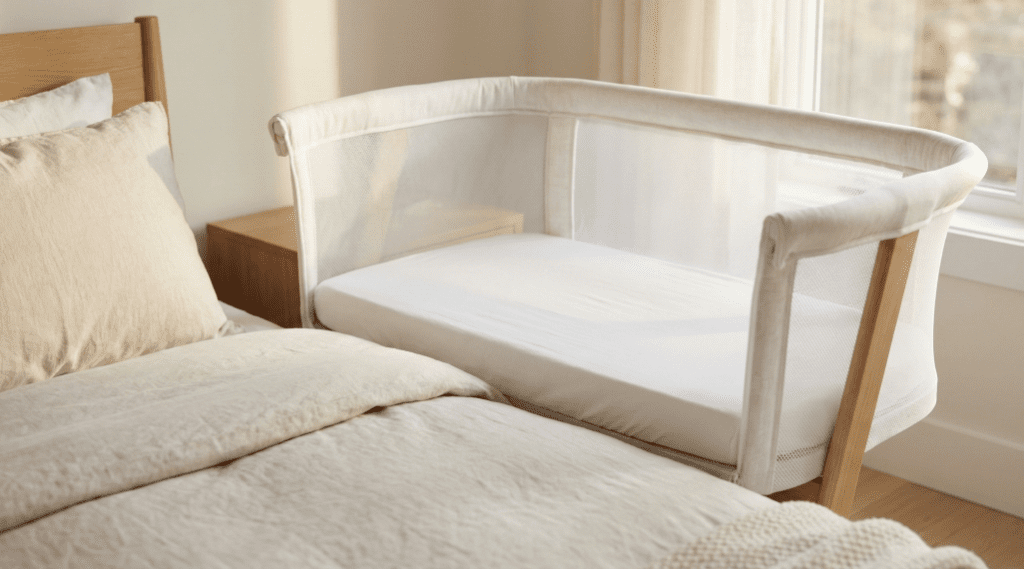
Bedside Co-Sleepers (The C-Section Savior)
These are designed to pull right up to your mattress, often with drop-down walls. For mothers recovering from C-sections, the ability to push the bassinet away to exit the bed without twisting is a medical advantage.
📖 Read More: The 10 Best Bedside Sleepers for C-Section Moms (Easy Access & Safety)
- Best For: Breastfeeding moms and C-section recovery.
- Pros: The Halo BassiNest offers a swivel feature that allows the bassinet to hover over your bed, meaning you don’t have to twist your abs to pick up the baby.
- Cons: They are heavy and have a large footprint. Also, watch out for the “tilt” issue in some swivel models where the bed isn’t perfectly level.
Pro Tip: Once you choose your bassinet, you’ll need to organize the area around it.
📖 Check Out: 12 Cozy Bedside Bassinet Stations: Organizing Diapers, Wipes, and Snacks for Night Feeds
Smart Bassinets (The “Night Nurse”)
These use algorithms to detect crying and respond with motion and white noise.
- Best For: Parents desperate for sleep extension (all of us?) and tech-lovers.
- Pros: The SNOO Smart Sleeper is the only bassinet with a clipped-in swaddle that physically prevents rolling, keeping the baby safely on their back all night.
- Cons: The price tag is eye-watering (~$1,700 new), though rental options exist. There is also the fear of “weaning”—eventually, the baby has to learn to sleep without the rocking.
📖 The Money Talk: Is the SNOO Worth $1,700? A Brutally Honest Review of Smart Bassinets vs. Renting
Travel Bassinets (The Minimalist)
Lightweight, foldable, and often sitting on the floor. If you are planning summer vacations or visiting grandparents, you need something that actually fits in a car or overhead bin.
📖 Read More: Flying or Driving? The Best Travel Bassinets That Actually Fit in a Carry-On
- Best For: Apartment dwellers, frequent flyers, or secondary caregivers (grandma’s house).
- Pros: The Guava Lotus folds into a backpack for overhead bins. Floor-level designs have zero tip risk.
- Cons: If you have a bad back, bending all the way to the floor to pick up a 15lb baby is a workout.
Deep Dive: The Engineering of a Good Night’s Sleep
We need to look beyond the marketing fluff of “breathability” and look at the actual engineering.
Mattress Tech: Breathability vs. Marketing
“Breathable” is a buzzword, but it means two different things in engineering terms:
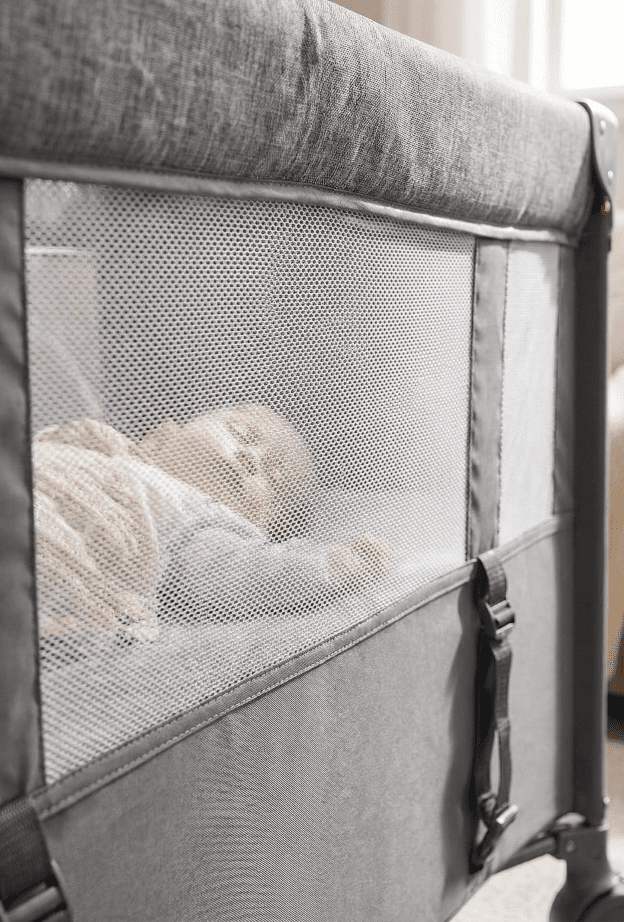
- Passive Airflow (Sidewalls): This is the mesh around the sides. Models like the Newton and Halo feature 360-degree mesh, which prevents CO2 from pooling inside the basin if the baby’s nose gets close to the edge.
- Active Permeability (Core): This is the mattress itself. Traditional vinyl-covered foam is impermeable. However, newer tech like the Newton Wovenaire uses a polymer matrix that is 90% air by volume. This allows a baby to breathe through the mattress if they accidentally roll face down.
The Danger of Aftermarket Mattresses
This is a critical safe sleep environment warning. Do not—I repeat, do not—buy a generic “universal” mattress for your bassinet. Manufacturers design their bassinets with precise internal dimensions. A generic mattress that is even 1 inch smaller in length or width can create a deadly gap between the mattress edge and the mesh wall. An infant can slip into this gap and become entrapped. Always use the mattress provided by the manufacturer or one explicitly approved by them. [Link to CPSC Bassinet Safety Page]
🛑 Emily’s Real Talk Corner #2: The 3 AM Diaper Blowout
You are asleep. Suddenly, you hear the unmistakable sound of a “poo-nami.” You turn on a dim light and see it: the leak has soaked through the swaddle, the sheet, and onto the mattress pad.
Do not try to change a tight fitted sheet in the dark while a naked baby screams. Use the “Double Sheet Protocol”.
The Setup: Mattress -> Waterproof Pad -> Sheet -> Waterproof Pad -> Sheet.
When disaster strikes, you just peel off the top wet layer (sheet + pad), and boom—there is a clean, dry set waiting underneath. You throw the dirty one in the hamper and go back to sleep. You’re welcome.
Operational Hygiene: Keeping It Clean
We talked about the sheets, but what about the mesh walls?
How to Clean the Mesh (Without Ruining It)
If your baby has projectile spit-up (it happens), scrubbing mesh with a rag often just pushes the gunk deeper into the holes, where it can smell or grow mold.
- The Hack: Use a portable garment steamer to loosen the dried residue, then gently scrub with a clean toothbrush dipped in baby-safe detergent water. The steam sanitizes without soaking the composite board frame. Blot dry with a towel immediately.
📖 Step-by-Step Guide: Spit-Up & Diaper Blowouts: How to Deep Clean Your Bassinet Mattress and Mesh Sides
Top Bassinet Recommendations (Based on 2026 Safety Specs)
We have analyzed the market based on the new ASTM F2194-25 standards to find the winners for every lifestyle.
Best for C-Section Recovery: Halo BassiNest 3.0

If you are having surgery, your core muscles will be out of commission. The Halo’s “swivel and hover” design is a medical necessity for many moms.
- The Win: The base slides under your bed, allowing the bassinet to hover over your mattress. You can bring the baby right to your face for reassurance without getting up.
- The Watch-Out: The cantilever design can sometimes “tilt” if your floor isn’t perfectly even. Use a bubble level during assembly. If it tilts >7 degrees, do not use it—gravity can roll the baby to the side.
📖 Also Read: Halo BassiNest 3.0 Review: A C-Section Lifesaver?
Best for Sleep-Deprived Parents: SNOO Smart Sleeper
Is it a bassinet or a robot nanny? It’s both.
- The Win: The “clipped-in” wings on the swaddle are the only device on the market that guarantees the baby stays on their back.
- The Economics: It’s expensive (~$1,695), but the resale value is incredibly high (~$900-$1,100). Buying used and reselling it often costs you less net money (~$200) than renting it for 6 months (~$1,112).
- The Watch-Out: It requires Wi-Fi and can struggle with modern 5GHz mesh networks.
💡 Pro Tip (Connectivity Hack): If your SNOO won’t pair, set up a mobile hotspot on your phone using 2.4GHz, pair the SNOO to that first to update the firmware, then switch it to your home Wi-Fi.
Best for Travel & Small Spaces: Guava Lotus
- The Win: It folds into a backpack shape. This is critical because unlike the BabyBjorn (which folds like a flat briefcase), the Guava fits into the smaller overhead bins of regional jets.
- The Safety: It sits on the floor, so there is zero risk of it tipping over.
- The Watch-Out: The deep bend to pick up the baby can be tough on your back.
The Exit Strategy: Transitioning to the Crib
One day, you will look at your bassinet and realize your tiny newborn looks huge. The bassinet vs crib transition usually happens between 4 and 6 months, but safety dictates the timeline.
When is it Time? (The Safety Deadlines)
You must stop using the bassinet immediately if any of these happen:
- Rolling Over: If your baby starts rolling, the swaddle must go.
- Pushing Up: Once they can push up on hands and knees, they can vault over the side.
- Growth Limits: If there is less than 1 inch of clearance between their head/feet and the bassinet walls, they have outgrown it.
📖 Safety Check: Is Baby Too Big? 5 Signs It’s Time to Ditch the Bassinet for a Crib (Safety Check)
The “Weaning Mode” and Logistics
If you used a smart bassinet like the SNOO, don’t go cold turkey.
- Use Weaning Mode: Activate this 1-2 weeks before the transition. It stops the constant motion and only rocks if the baby cries.
- Naps First: Start by doing daytime naps in the big crib to build familiarity with the new room.
- The Scent Transfer Trick: Babies are guided by smell. Sleep with the clean crib sheet in your bed for a night before putting it on their mattress. Your scent will make the strange new environment feel familiar.
📖 How-To Guide: How to Transition Your Baby from Bassinet to Crib: A Step-by-Step Sleep Training Guide
🛑 Emily’s Real Talk Corner #3: The “Empty Room” Anxiety
The first night my son slept in his crib in the nursery, I stared at the baby monitor for 4 hours straight. The room next to me felt painfully empty.
This transition is often harder on us than it is on them. It is okay to be anxious. It is okay to check the monitor a hundred times. But trust the milestones. If they are rolling or pushing up, they are telling you, “Mom, I’m strong enough for the big bed.” You did your job keeping them safe in the bassinet; now they are ready for the next stage.
Buying Used? Read This Warning First
I love a good deal, but the secondhand market for baby gear is a minefield of recalls and degradation.
📖 Must Read: Is It Safe to Use a Second-Hand Bassinet? 5 Checks to Perform Before You Buy
The Used Mattress Danger
Never, ever use a used mattress from a stranger. Foam degrades and softens over time, losing that critical firmness we talked about earlier. Bacteria and mold can also grow inside the core. Always buy a brand-new replacement mattress certified for that specific model.
Recall Checklist
Before you hand over cash for a used bassinet:
- Check the CPSC Database: Recalls happen constantly. Recently, the Beberoad Love New Moon and DaVinci Bailey were recalled for fall hazards.
- Look for the Seal: In late 2025, the JPMA rebranded to the Baby Safety Alliance (BSA). Look for the BSA Verified Seal (or the older JPMA seal) to ensure the product was lab-tested to meet ASTM standards.
Conclusion: You’ve Got This
The “best” bassinet isn’t the most expensive one, and it isn’t the one your favorite influencer has. It is the one that fits your bedroom, your budget, and keeps your baby safe on a flat, firm surface.
Whether you choose the high-tech robot or the simple mesh rectangle, you are making a choice rooted in love and safety. Now, go measure your bedside space, order that bassinet, and try to get some rest yourself. You’re going to need it.
FAQs
What is the most important safety feature to look for in a bassinet?
Look for a flat, firm sleep surface with an incline of 10 degrees or less to prevent positional asphyxiation . Ensure the product bears the JPMA or Baby Safety Alliance (BSA) seal, indicating it meets the strict ASTM F2194-25 safety standards.
How long can a newborn sleep in a bassinet?
Most babies outgrow bassinets between 4 to 6 months. You must discontinue use immediately if your baby begins to roll over, pushes up on their hands and knees, or reaches the manufacturer’s specific weight or height limits .
Is it safe to buy a used bassinet?
Buying used carries significant risks. Never reuse a mattress from a stranger, as foam degrades and harbors bacteria; always purchase a brand-new, manufacturer-approved replacement mattress . Additionally, verify the model number against the CPSC database to ensure it has not been recalled.
Why does the bassinet mattress feel so hard?
A firm surface is a critical medical requirement to prevent SIDS and suffocation. Soft surfaces can conform to a baby’s face, creating a seal that leads to the rebreathing of carbon dioxide and potential hypoxia.
Can I add a pillow or soft bedding to the bassinet?
No. The American Academy of Pediatrics (AAP) recommends a “naked” sleep space containing only the baby and a tight-fitted sheet. Pillows, bumpers, and weighted swaddles pose severe suffocation and entrapment hazards.
Are inclined sleepers safe for newborns?
No. Following the CPSC’s 2022 Infant Sleep Product Rule, inclined sleepers are banned. Current standards mandate a sleep surface angle of 10 degrees or less to prevent the infant’s head from slumping forward and compressing the trachea.
Do I need a bassinet if I have a crib?
While a crib is safe from birth, the AAP recommends room-sharing (but not bed-sharing) for the first 6 months to reduce SIDS risk by 50% . A bassinet’s smaller footprint makes it easier to keep the baby within arm’s reach of your bed.
What is the safest type of bassinet for C-section recovery?
Bedside bassinets with a swivel feature, like the Halo BassiNest, are often recommended for C-section recovery. They allow the bassinet to hover over the bed, bringing the baby close so you can lift them without twisting or straining your abdominal muscles .
Why are mesh sides recommended for bassinets?
Mesh sidewalls facilitate passive airflow, which prevents carbon dioxide from pooling inside the basin if the baby moves near the edge . This cross-ventilation also reduces the risk of overheating, a known cofactor for SIDS.