
If you are reading this Halo BassiNest 3.0 Review, chances are you are heavily pregnant, planning your nursery, and terrifyingly aware that you’ll soon be functioning on very little sleep. Or perhaps you are already in the thick of it—the fourth trimester—searching for a way to keep your baby close without physically getting out of bed every forty-five minutes.
I remember that feeling vividly. The fear of the “crunch.” You know the one—that sharp, searing pull in your lower abdomen when you try to sit up in bed using your core muscles. For moms recovering from a C-section, that simple movement can feel impossible. Even for moms with a vaginal birth, the exhaustion of physically lifting yourself out of a high mattress to reach into a standard bassinet creates a level of friction that makes the nights feel twice as long.
The HALO BassiNest Swivel Sleeper 3.0 claims to be the solution to this specific nocturnal struggle. It’s the only bassinet that swivels 360 degrees and glides right over your mattress, bringing the baby to you rather than forcing you to go to the baby. But with a premium price tag compared to standard bedside sleepers, is that swivel function actually a necessity, or just a nice-to-have gimmick?
In this deep-dive review, we are going to stress-test the Halo 3.0 against the realities of new motherhood—from assembly headaches to 3 AM diaper changes—to help you decide if it’s the right investment for your recovery.
Quick Verdict
If you are skimming this while nursing or bouncing a fussy baby, here is the bottom line on whether the Halo BassiNest 3.0 is worth the investment.
| Feature | Rating | Why? |
| Safety | ⭐⭐⭐⭐⭐ (5/5) | Breathable mesh and sturdy base. |
| Aesthetics | ⭐⭐⭐⭐ (4/5) | Sleek, modern, fits most decors. |
| Ease of Use | ⭐⭐⭐⭐⭐ (5/5) | The swivel is a game-changer. |
| Value | ⭐⭐⭐⭐ (4/5) | Pricey, but essential for recovery. |
Overall Rating: 4.8/5
The Bottom Line: The Halo BassiNest 3.0 is the gold standard for C-section recovery, allowing you to tend to your baby without twisting your core or leaving your bed.
Best For: C-section moms, nursing mothers, and small bedrooms.
Not Best For: Budget-conscious parents or those needing a lightweight travel option.
[Check Latest Price on Amazon]
Why The Swivel Matters: Key Features & Real-World Benefits
When you look at a spec sheet, features like “360-degree rotation” sound fancy, but abstract. As a mom, I don’t care about the engineering; I care about how it changes my night. The Halo BassiNest isn’t just a container for the baby; it is designed to be an extension of your own bed, and that distinction is crucial for a few specific reasons.
The 360-Degree Swivel
This is the headline feature, and frankly, it is the primary reason you buy this bassinet. Most bedside sleepers, like the Arm’s Reach or Maxi Cosi, sit next to your bed. They are static. To get the baby, you have to scoot to the edge of your bed, sit up, and reach over.
The Halo, however, sits on a dual-swivel mechanism. The base stays tucked under your bed, but the sleeping area floats. You can pull it literally onto your mattress, so the baby is sleeping inches from your face. When you need to get out of bed, you simply push it away.
For moms recovering from surgery, this is non-negotiable. The Halo Bassinest for C-Section recovery is unmatched because it eliminates the “twist and lift” motion. You can remain in a reclined position, gently pull the bassinet over your lap, scoop the baby up for a feed, and put them back—all without engaging your compromised abdominal muscles. It turns a painful physical ordeal into a manageable slide.
The Lowering Bedside Wall

One of the biggest frustrations with deep bassinets is the “drop.” Putting a sleeping baby down is an art form; if you have to lean far over a rigid wall and extend your arms down, the shift in gravity often wakes the baby up.
The Halo 3.0 features a lowering bedside wall on the side facing the parents. You can unlock it so that when you lean on it with your forearms, it gently lowers under your weight. This allows you to slide the baby onto the mattress rather than dropping them. It also means you can lie in bed, lower the wall with your hand, and soothe your baby with a hand on their chest without having to get up.
The Detachable Bed (A 3.0 Upgrade)

Previous versions of the Halo were heavy, single-unit beasts. Once you set it up in the bedroom, it stayed there. The 3.0 version introduces a detachable “nest.” You can pop the sleeping basket off the heavy base and move it to the living room or kitchen floor.
While I wouldn’t call it a “portable” bassinet in the travel sense (it’s still bulky), this feature adds value. It means you don’t necessarily need to buy a separate lounger or Moses basket for the living room during those early weeks when the baby sleeps 18 hours a day.
The “New Mom” Stress Test: Ease of Use
It looks great in photos, but how does it handle the chaos of real life? Let’s break down the logistics.
Halo Swivel Sleeper Assembly
Let’s be honest: assembling furniture at 38 weeks pregnant is not anyone’s idea of a good time. The Halo swivel sleeper assembly is straightforward, but it is heavy. The base is weighted significantly to prevent tipping (which is a good thing for safety), but it makes the box difficult to maneuver alone.
The 3.0 model snaps together easier than previous generations. It largely involves clicking the legs into the base and attaching the nest. However, I strongly recommend doing this before you bring the baby home. It is a one-person job if you are physically capable, but given the weight of the base, this is a perfect task to delegate to a partner or helpful friend. You will need a screwdriver for the batteries if you opted for the Soothing model, but the frame itself is mostly tool-free.
Height Adjustment and Bed Fit
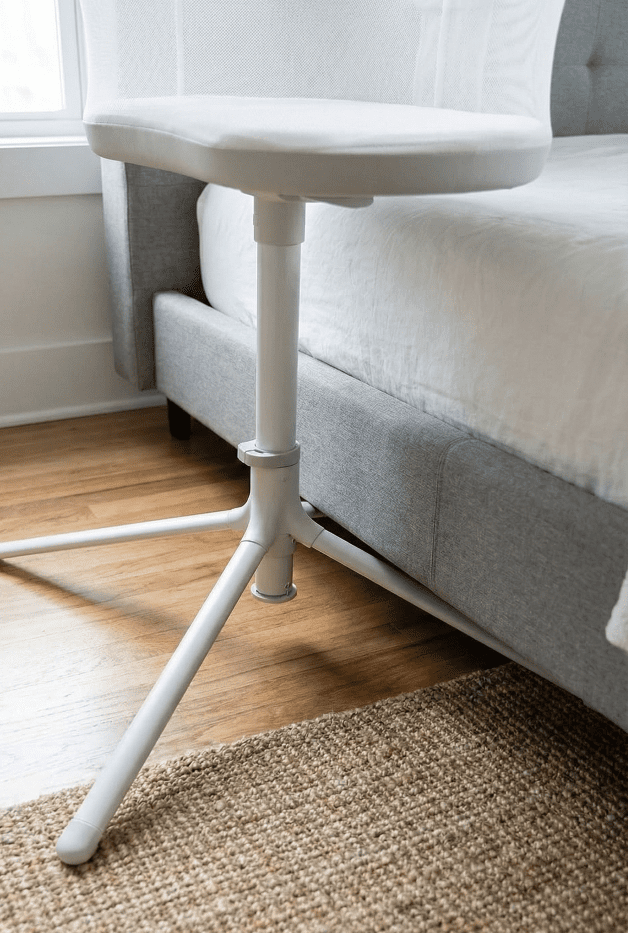
The Halo is designed to work with almost any bed, including high master beds. It adjusts from 24 to 34 inches tall. However, there is a catch: the legs.
The base legs are designed to slide under your bed so the bassinet can get close. If you have a platform bed that sits flush with the floor, or a bed frame with very low clearance (less than 3 inches), the legs won’t slide under. In that scenario, the Halo is forced to sit further away from the bed, rendering the swivel feature much less effective. Before you buy, get a tape measure and check the gap between your floor and your bed frame.
Cleaning: The Spit-Up Reality
Babies are messy. Between diaper blowouts and reflux, your bassinet will get dirty. The Halo 3.0 has improved significantly here. The fabric “nest” zips off and is machine washable.
This is a massive improvement over older bassinets where the fabric was stapled or glued to the board. However, taking the fabric off requires a bit of wrestling with zippers and clips. It’s not something you want to do at 2 AM. My advice? Buy a waterproof mattress pad and fitted sheets specifically for the Halo (the hourglass shape requires specific sheets) to protect the main unit so you aren’t stripping the whole thing down constantly.
Safety & Stability Check
As a new mom, your anxiety is likely running high. Is it safe? Is it flat enough? Is it sturdy?
Breathable Mesh Walls

The entire perimeter of the Halo BassiNest 3.0 is made of breathable mesh. This serves two purposes. First, it reduces the risk of suffocation if the baby ends up pressing their face against the side (though you should always place baby on their back). Second, it provides visibility. You can open your eyes in the dark, look through the mesh, and see your baby’s chest rising and falling without having to sit up.
Sturdiness vs. The Wobble
Because the Halo sits on a single pedestal rather than four corner legs, some parents worry about the “wobble.” It is true that the sleep surface is not as rigidly fixed as a traditional crib. It has a slight flex to it. This is intentional to allow for the movement, but it can feel disconcerting at first.
Rest assured, the base is incredibly heavy and stable. Even if you have a toddler running around the room or a dog that jumps near the bed, the 4-point base makes it nearly impossible to tip over.
Certification and Recalls
The Halo BassiNest is JPMA certified and meets all ASTM safety standards for bassinets. However, vigilant parents often worry about product history. It is always smart to perform a Halo Bassinest safety recall check before using a hand-me-down or second-hand unit. While the 3.0 is the newest model and meets current standards, older versions have had advisories regarding proper assembly and use. Buying new ensures you have the latest locking mechanisms and safety updates.
Real-World Pros & Cons
Here is the brutally honest breakdown of what I loved and what drove me crazy.
Pros
- The Swivel: I cannot overstate this. Being able to pull the baby onto the bed for a feed and push them away to sleep is the single greatest feature for postpartum recovery.
- Visibility: The 360-degree mesh means I never had to panic-check if the baby was breathing; I could just look.
- Small Footprint: Because the legs slide under the bed, it takes up very little actual floor space in a small bedroom.
- Soothing Options: If you get the upgraded model, the halo smart bassinet autosooth features (vibration and white noise) can be helpful. However, note that the basic 3.0 does not always include the full smart suite, so check the specific sub-model you are buying. The vibration specifically is often the magic trick for fussy newborns.
Cons
- The “Trip” Hazard: The legs of the base are long and stick out slightly from under the bed. In the middle of the night, it is very easy to stub your toe on the heavy metal legs.
- Uneven Surface: Some users report that because of the single-arm support, the bassinet can tilt slightly if the baby is heavy and positioned on the far edge.
- Price: It is significantly more expensive than a simple stationary bassinet.
- Short Lifespan: Like all bassinets, this is a short-term gear item. Your baby will outgrow it by 5 months or whenever they start rolling over or pushing up on hands and knees.
Halo BassiNest vs. The Competition
While the Halo is often the default choice for surgery recovery, it isn’t the only option. (You can see our full breakdown of The 10 Best Bedside Sleepers for C-Section Moms for a wider list of alternatives). However, in this review, we will focus on its two biggest rivals: the SNOO and the standard bedside sleeper.
Comparison 1: Halo Bassinest vs SNOO
This is the heavyweight title fight. The SNOO Smart Sleeper is famous for its robotic soothing—it automatically rocks and shushes the baby when they cry.
- The Difference: The SNOO is a “robot nanny” focused on extending sleep. The Halo is a “mobility tool” focused on accessibility. The Halo does not rock the baby automatically.
- The Price: The SNOO costs nearly 3-4x what the Halo costs.
- The Verdict: If you have the budget and are terrified of sleep deprivation, the SNOO is incredible technology. But for C-section moms, the SNOO is stationary. It doesn’t swivel over the bed. You still have to get up to get the baby out. For physical recovery, the Halo Bassinest vs SNOO debate actually favors Halo.
Comparison 2: Halo vs. Standard Bedside Sleepers (Arm’s Reach / Maxi Cosi)
Competitors like the Arm’s Reach Clear-Vue or the Maxi Cosi Iora are excellent, safe options. They usually feature a drop-down side and strap to the bed.
- The Difference: These are “sidecar” bassinets. They attach to the side. They do not swivel over your lap.
- The Price: They are generally cheaper than the Halo.
- The Verdict: If you had a vaginal birth and have good core mobility, the Maxi Cosi or Arm’s Reach are fantastic and often have larger storage baskets. But they lack the swivel. If you are recovering from surgery, the few inches of difference between “side of the bed” and “over the bed” feels like miles.
Who Should Buy This (And Who Should Skip)

Buy the Halo BassiNest 3.0 If:
- You are having a C-section: This is the primary use case. It allows you to care for your baby while adhering to doctor’s orders about lifting and twisting.
- You have a tall bed: The height adjustability is superior to many cheaper brands.
- You have a tiny bedroom: If you don’t have 2-3 feet of clearance beside your bed for a bulky bassinet, the Halo’s low-profile base is a life saver.
Skip It If:
- You have a platform bed: If the legs can’t slide under your bed, the bassinet will sit too far away, defeating the purpose.
- You are on a tight budget: You can safely sleep your baby in a $100 bassinet or a Pack ‘n Play. The Halo is a luxury of convenience, not a requirement for safety. (If you need to prioritize your budget elsewhere, our Bassinet Buying Guide (2026): The Safest Options for Newborn Sleep breaks down the best high-value alternatives).
- You need travel gear: This thing is heavy. You are not taking it to Grandma’s house for the weekend.
FAQ Section
How long can a baby use the Halo BassiNest 3.0?
Babies can use the Halo BassiNest until they are approximately 5 months old, or reach 20 lbs. However, the most important milestone is mobility. You must stop using the bassinet the moment your baby shows signs of rolling over or pushing up on hands and knees, as the shallow depth becomes a safety risk.
Is the Halo BassiNest safe for newborns?
Yes, it is JPMA certified and meets safety standards. It provides a firm, flat sleep surface which is the only safe way for newborns to sleep. The mesh walls ensure airflow, reducing suffocation risks compared to padded bumpers.
Does the Halo BassiNest 3.0 vibrate?
This depends on the specific model. The “Essentia” series usually does not have electronics. The “Premiere” or “Soothing” models include the halo smart bassinet autosooth center with vibration, amber nightlights, and white noise. Always check the specific box to ensure it includes the soothing unit if that is important to you.
How do I clean the mesh walls?
With the 3.0 model, the entire sleeping nest can be unzipped from the frame and is machine washable. Wash it on a delicate cycle with cold water and air dry it (do not put it in the dryer to prevent shrinking the mesh).
Does the Halo BassiNest fit all bed heights?
It fits most, but not all. It adjusts from 24 to 34 inches high. The critical factor is the clearance under your bed. You need at least 3 to 4 inches of space between the floor and your bed frame for the legs to slide underneath. If you have a solid box platform bed, the Halo will not work as intended.
Final Verdict
The Halo BassiNest 3.0 is a product that understands the physical reality of the fourth trimester. It acknowledges that mom is healing while the baby is growing.
Is it perfect? No. The base is heavy, and it’s a short-term investment. But for the 3 to 5 months that you use it, it offers something that no other bassinet does: the ability to parent from your pillow. When you are exhausted, sore, and overwhelmed, the ability to simply pull your baby close with one finger is worth every penny.
It saves your back, it protects your C-section incision, and it keeps your baby safe. For those reasons, it gets the New Mamaa stamp of approval.